Category: News

News is timely.

  • 2023 Highlights

    2023 Highlights

    In just over two years, the California for All Animals program has provided nearly $31.5 million in funding to animal shelters across the state. Funding has supported spay/neuter surgeries, veterinary care, supplies, equipment and staffing to keep pets and people together. The 2023 funding strategy was to provide support and partnership on grants awarded in 2022, continue to bridge the 3M spay/neuter surgery gap created during the Covid-19 pandemic, and continue to remove barriers and expand access to care.

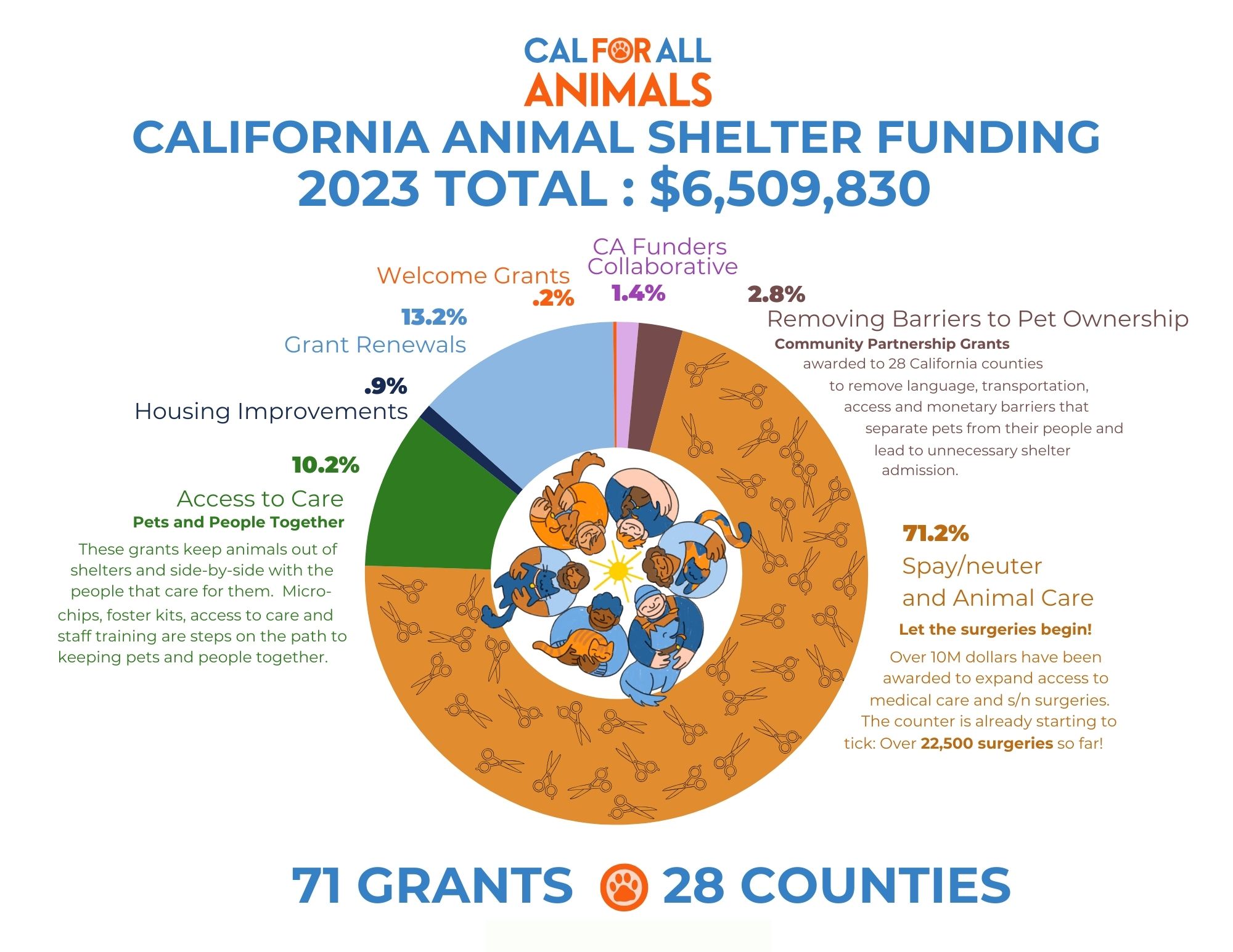
    Read below to learn more about how the 6.5M 2023 grant support was distributed to support California families and their well-being.
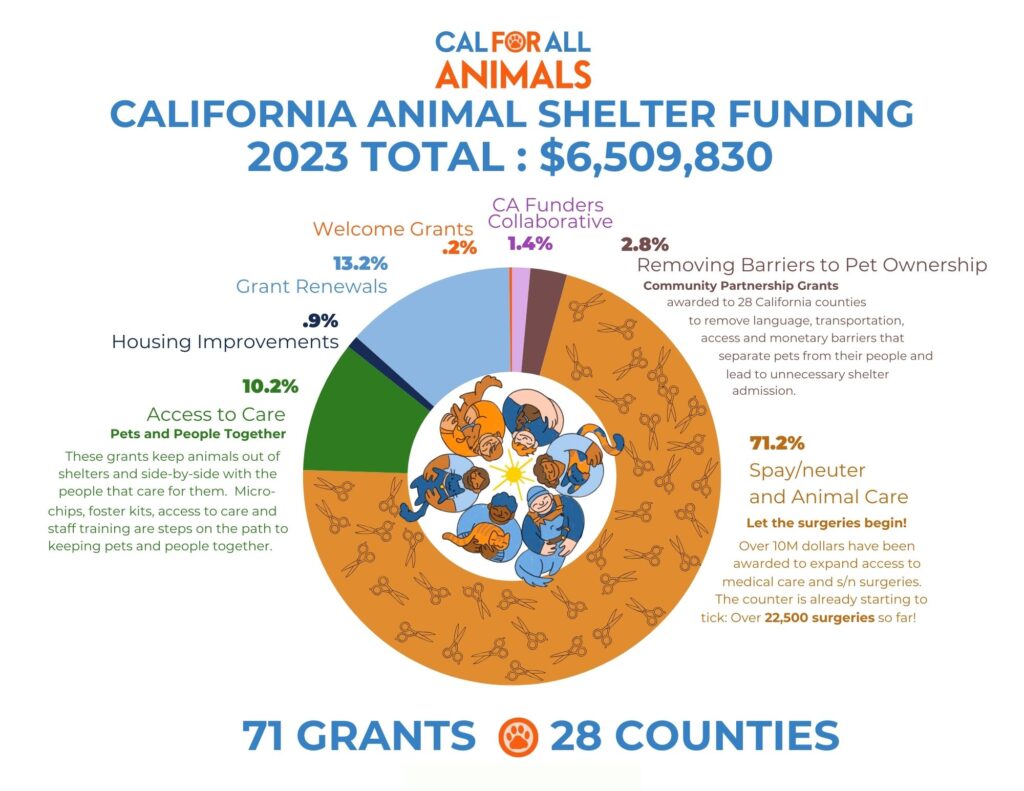
    Chart showing distribution of grant funds. Details are also in the text on this page.
    • Grant funding has been awarded for shelters to expand surgery capacity and partner with spay/neuter organizations such as CAMP LA, SNIP Bus, Valley Oak SPCA, and Animal Balance to provide low-cost or fully subsidized spay/neuter, vaccinations, and microchips to keep pets in their homes and prevent additional litters of puppies and kittens. Accessible spay/neuter promotes animal health, stabilizes community cat populations, and reduces the number of animals entering shelters. Over 4M dollars was awarded in 2023 expand access to spay and neuter.

    • Grants made to animal control agencies and municipalities with animal control officers help keep pets in homes. Providing supplies like pet food, crates, fencing repair, and outdoor trolley systems keep pets with the families who already love and care for them. Supportive practices build relationships and address root issues that result in pet homelessness. For example, working with the community to help lost animals stay in their neighborhood improves the chances of that pet returning to their home by a factor greater than 10! Solution-focused programming allows animal control officers to move away from costly, punitive programming that breaks the bonds between pets and families and fills our shelters with pets who already have homes. Resources can be reallocated to focus on animals who do need intervention and enforcement, such as intentional cruelty, domestic violence cases and suspected dog fighting or cock fighting. Over $100,000 dollars have been awarded to support animal control agencies building proactive programs.

    • Grants made to ensure essential pet services are accessible and inclusive for all Californians. Funding prioritizes bridging the gap between animal shelters and communities that have been disproportionately impacted by racial and economic inequities.Translating materials, hiring multilingual staff and collaborating with human service agencies and other community-based organizations ensures animal shelters can partner with all community members to keep the pets they love by their side.. Over $200,000 dollars have been provided to bridge the gap between California families and access to essential services and resources.

    • Grants made to community support programs that keep pets with their people. When people are suffering, their pets are too. Animal shelters are partnering with human services agencies and community-based organizations to provide food and supplies, behavior and training services, vaccine clinics, veterinary care, and temporary crisis boarding to keep pets with the people who care for them. Programming and partnerships also provide crucial support and advocacy for Californians experiencing homelessness or domestic violence, with a focus on pet- and people-centered support that removes barriers to accessing safe and permanent housing. Over $500,000 dollars have been awarded to support California programs that keep pets in their homes.

    • Grants made to foster programming keep vulnerable pets out of shelters. Engaging community members in the temporary care of kittens, puppies and any other pet who would benefit from a home environment allows pets to benefit from socialization and extra care. Shelters are providing the supplies and medical care needed to support foster caregivers preparing animals for adoption. Foster programs allow shelters to expand the care they give to animals in need, reduce the transmission of diseases, increase adoptability of all animals, and reserve space and resources for the most vulnerable animals, those who are injured, receiving extensive medical care or in need of secure housing due to behavioral or custody concerns. Over $500,000 thousand dollars have been awared to keep vulnerable pets out of the shelter. 

    • Grants made to support the care of animals in the shelter improve the well-being of both animals and staff. When animals do need homes, funding provides for the physical, medical and mental well-being of animals who are in the shelter’s care. This includes veterinary care supplies and services, behavior and enrichment, volunteer programs, equipment and supplies, and housing improvements. Every single shelter in California has been invited to upgrade to double-compartment housing which reduces the spread of disease and improves staff safety. See the housing map here: https://www.californiaforallanimals.com/grants/portal-grants/ Over $300,000 dollars have been awarded to support the care of animals housed in California shelters.
  • Petting Pitties and Swapping Advice: Compassion in Action at The PAW Mission

    Petting Pitties and Swapping Advice: Compassion in Action at The PAW Mission

    More Pets and People
    Together…

    …more
    Compassion

    Petting Pitties and Swapping Advice: Compassion in Action at The PAW Mission

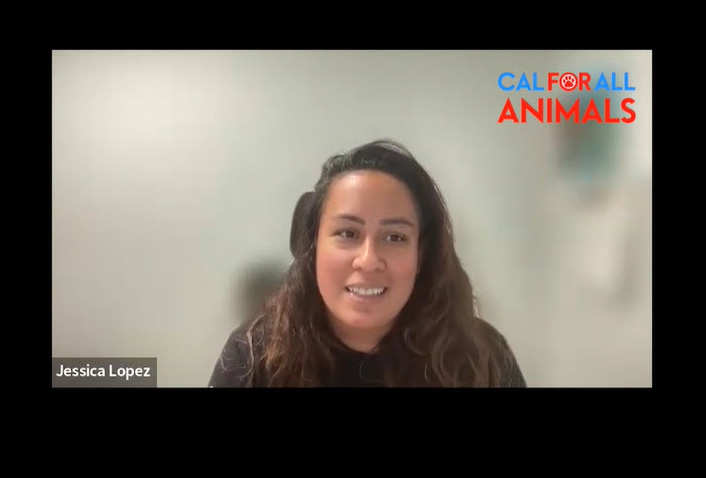
    As part of our More Pets and People Together campaign, we’re asking community members inside the shelter and out, “What do communities look like when we’re stronger side by side? What does More Pets and People Together mean to you?” Together we’re envisioning and creating communities that keep and bring pets and people together, places rooted in mutual care, joy, and connection, where everyone belongs. The PAW Mission Founder and Executive Director Jessica Lopez reflects on the people and circumstances that challenged her assumptions and cleared the way for a new understanding of what compassion looks, feels, and sounds like. 

    On Fridays the Pico Rivera Clinic opened at 6 a.m., and Jessica Lopez was sure Gloria would be first in line. Jessica had recently left work in the private practice veterinary world for a job managing two high-volume spay/neuter clinics for Spay/Neuter Project of Los Angeles, and she’d come to know Gloria through her weekly TNR routine. Without fail, Gloria would trap one of the many community cats she looked after, then line up in the dark at 5 a.m. for the clinic’s low-cost spay/neuter services so she could get in and out and still make it to her job by 6:30. 

    “Rain or shine. She was all business, always composed,” Jessica said. “One time we had a fire in the clinic. She was right there, like, ‘How can I help?’”

    That morning, though, when the doors opened, Gloria was distraught. One of the cats she’d waited in line with the week before had been hit by a car. “She was on the street,” she told Jessica through tears, “and I had to bring her in.”

    The community cats that passed through the clinic every day? For caregivers like Gloria, Jessica realized, they’re family.

    Over time Jessica questioned more of the assumptions she’d carried into the field. “I did a lot of emergency and critical care as a technician, and I was very dead set on the belief that if you did not have $1,500 in your bank account ready for an emergency, then you should not have a pet,” she said. “I was making 16 bucks an hour, and I’m expecting people to have $1,500? That wasn’t even one paycheck of mine.”

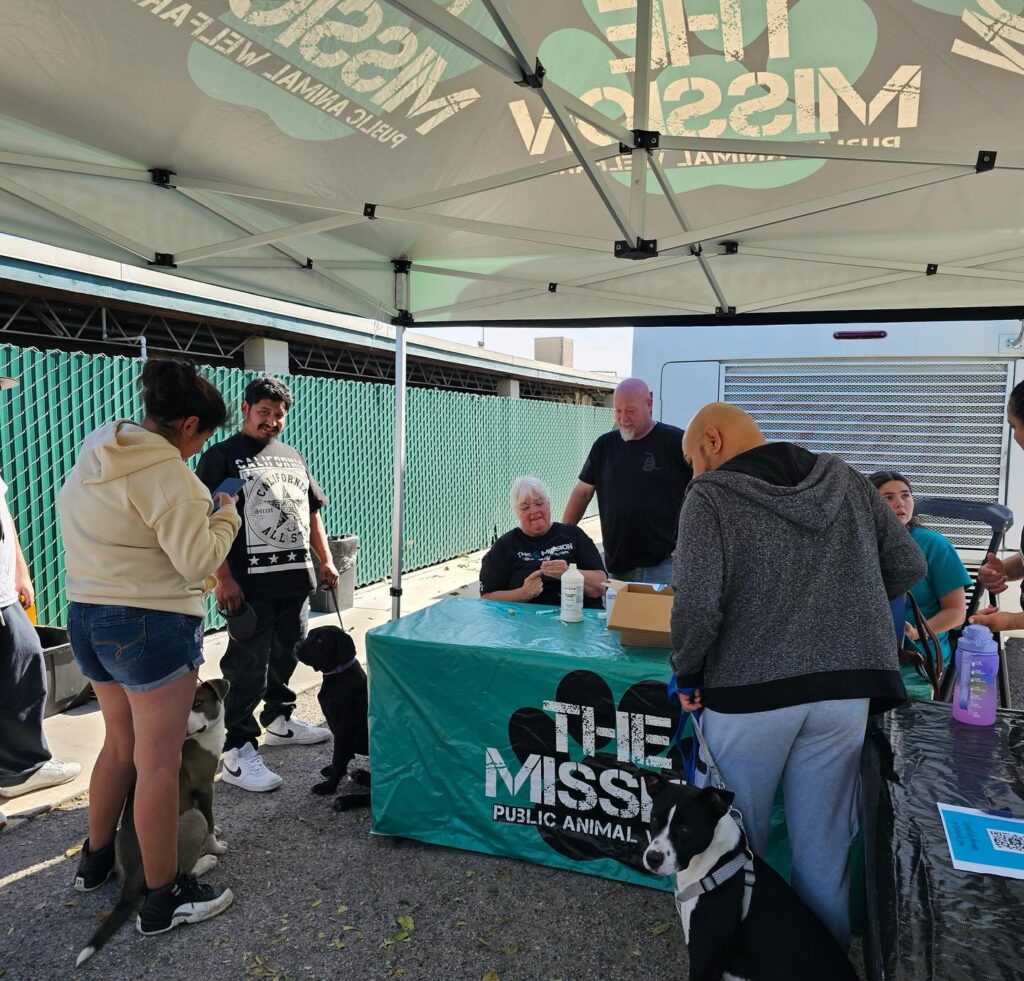
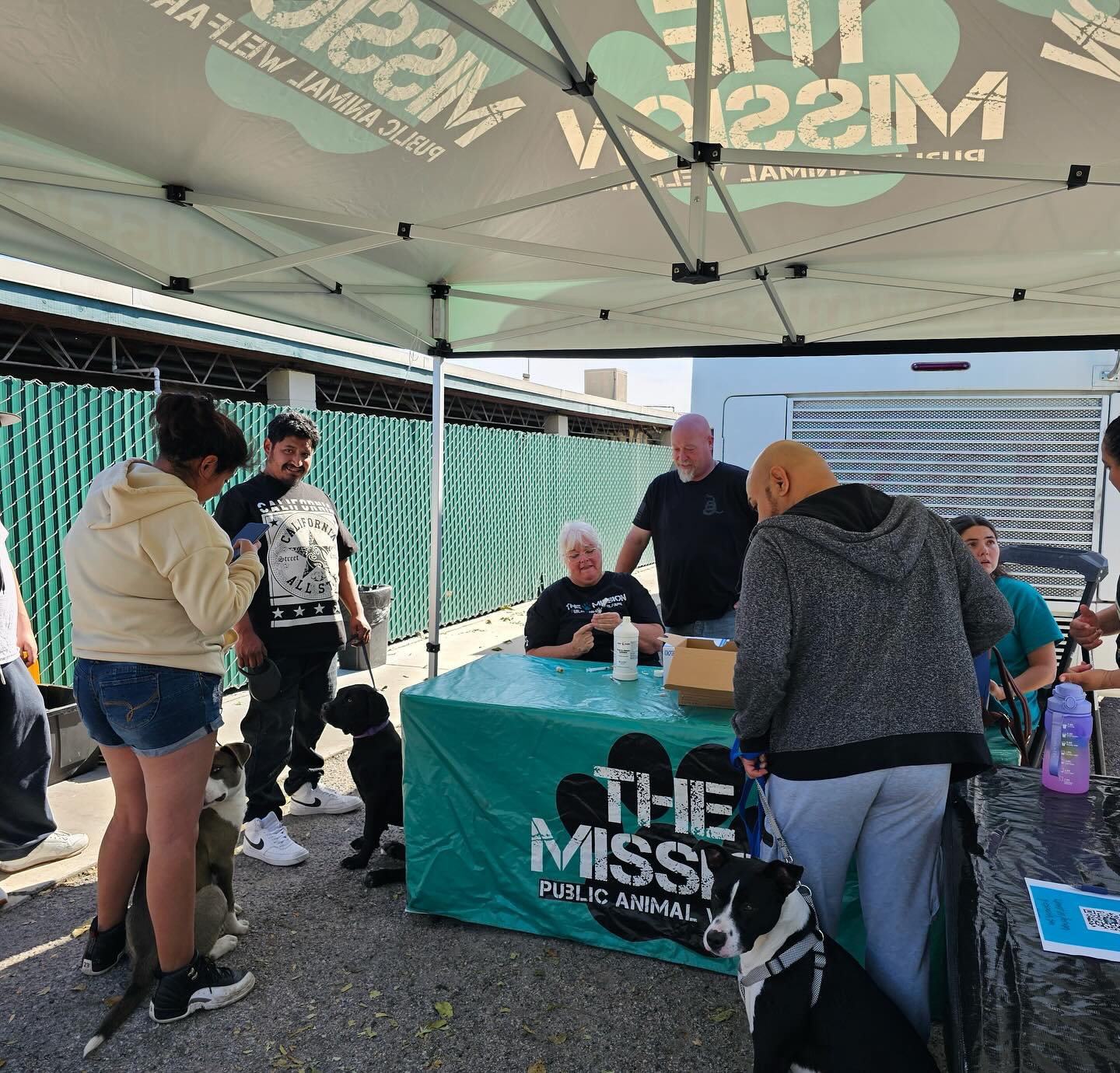
    The PAW Mission in action in San Bernardino. Credit: The PAW Mission

    At community events, people aren’t just standing in line for health checks, vaccines or pet food. They’re petting pitties and swapping advice with the people behind them or sharing stories with the cat parents in front of them.

    Photo courtesy The PAW Mission

    That expectation didn’t square up with her family’s experience either. “We always had pets. We never had an extra $1,500 in the bank account for anything. Ideally everybody has extra income for the emergency fund, for the rainy-day fund. But a lot of people—the majority of the U.S.—is struggling, and they’re going paycheck to paycheck.” 

    People like Gloria changed her views on what true pet care is and what animal care organizations could be offering. Now, through The PAW Mission, Jessica’s goal is to leave the assumptions behind and start with one question: “How can we help you?” Her team can support community members with pet food and supplies, free vaccines, spay/neuter, and low-cost vet care. They can share information or help them bring home a new pet or Rodent Ranger.  

    No matter what, it’s important to meet people where they are, with compassion, Jessica explained. “How are we going to impact our community if we’re constantly telling them that they’re doing something wrong, and we’re not trying to understand where they’re coming from?”  

    For Jessica, more compassion leads to more pets and people together, and it also leads to more voices and a stronger community. She sees it in action at every PAW Mission event. People aren’t just standing in line for health checks, vaccines or pet food. They’re petting pitties and swapping advice with the people behind them or sharing stories with the cat parents in front of them. They’re hanging out after on a nearby bench, laughing together in the sun. They’re realizing that neighbors—even the ones with the rambunctious dog—can also be friends. 

    It’s a change you can feel, Jessica said. “Everybody needs that village to help, whether it’s for pets or for kids.” 

    Three Minutes of Insight from Jessica Lopez

    On support networks

    On support networks

    0:54
    On changing minds

    On changing minds

    0:33
    On spay/neuter

    On spay/neuter

    0:24
    On the power of events

    On the power of events

    1:14

    Hear Jessica reflect on the support networks we all need in our lives, why the benefits of community events go beyond vaccinations, and how to rethink our approach to changing minds.

    Jessica Lopez

    Jessica Lopez serves as Executive Director/Founder of The PAW Mission, overseeing the organization’s management, programs and development. Jessica has worked in the veterinary field for over 20 years; for 14 of those years she worked building vital community programs, wellness clinics, vaccine clinics, and building great teams for organizations in both Los Angeles and San Bernardino. Jessica has always known she was going to work with either animals or children, and she is exhilarated to do both at The PAW Mission. Jessica resides in Yucaipa with her family (husband and three kids) and a menagerie of farm animals, including cows, goats, pigs, chickens, ducks, geese, turkeys, cats, and dogs!


    More Pets and People Together main page


    Back to top

  • Grant Impact – Tux from Tuolumne

    Grant Impact – Tux from Tuolumne

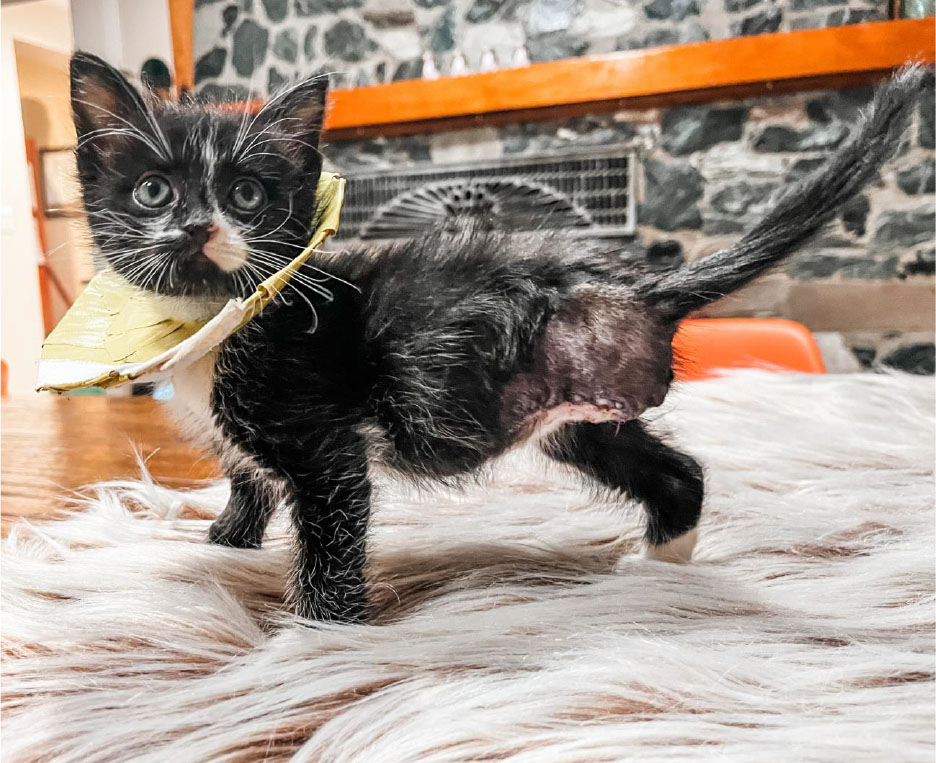
    Tux, a tripod cat helped with Cal4All Animals grant funds

    “Another happy story from our Cal for All Animals grant was Tuxedo (‘Tux’), a young kitten with a severely injured leg. Tux had been surrendered to Tuolumne County Animal Control, and they reached out to their rescue partners to find a transfer opportunity.

    “Because we knew we had our grant funding available, we accepted Tux and had him seen by a veterinarian immediately. It was decided that the best course of action for Tux was amputation of the limb (he had a severe fracture on one of the growth plates), and he recovered beautifully.

    “Tux was adopted about three weeks post-surgery and is living the good life in Angels Camp with his new mom and a Shih Tzu ‘sister.’”

    – Calaveras Humane

    “It’s impossible to express how much the discretionary funds of our Cal for All Animals grant not only helped pets in medical need, but improved the psychological well-being of our staff and volunteers. Knowing that a medical situation wasn’t a crisis, and that we could comfortably pay for it, was immeasurably valuable.

    “Similarly, the ability to say ‘yes’ to transfers of pets with pre-existing medical conditions from other shelters was an absolute joy.”

     — from the Calaveras Humane Society Cal for All Animals Grant 2022/2023 Final Report

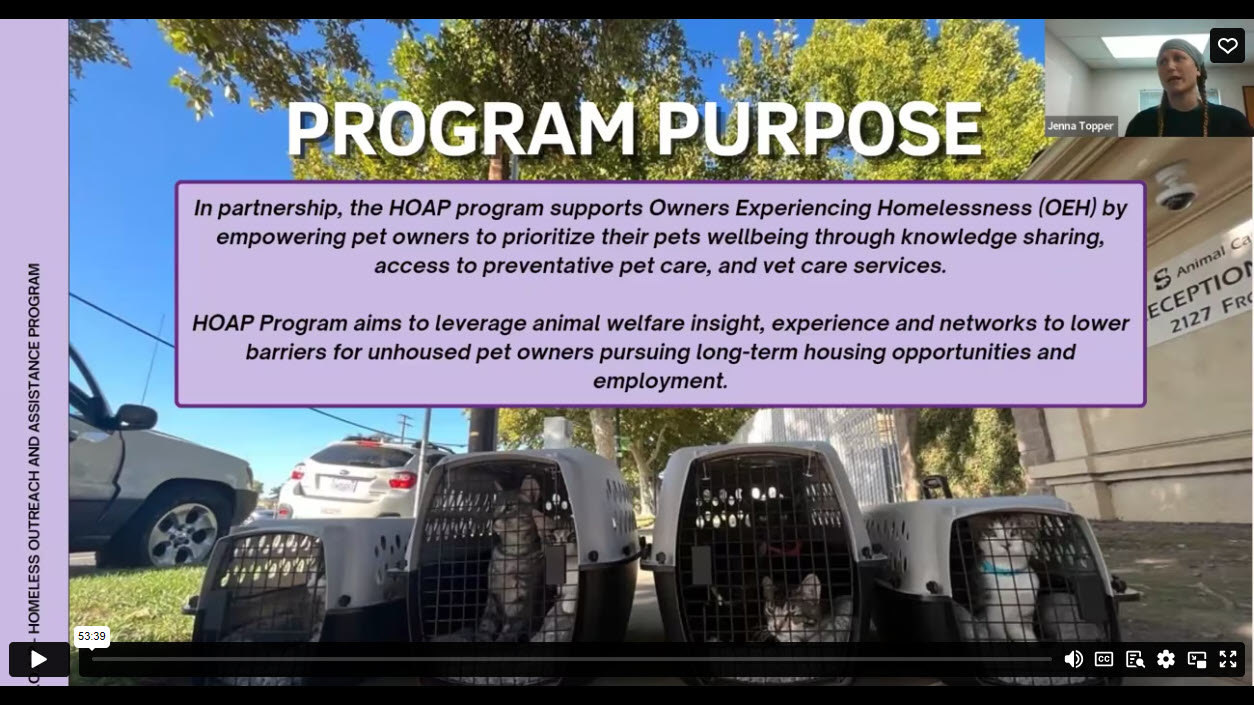
  • Jenna Topper Shares HOAP (the Homeless Outreach and Assistance Program)

    Jenna Topper Shares HOAP (the Homeless Outreach and Assistance Program)

    In this recording of the Feb. 20, 2024 Cal4All Call, Jenna Topper (Animal Services Coordinator) and Phillip Zimmerman (Animal Care Services Manager) talk about HOAP, the Homeless Outreach and Assistance Program launched in May 2022. The City of Sacramento Front Street Animal Shelter initiative aims to remove barriers and keep pets and people together in a city and county where over 4,000 people face chronic homelessness, second to only Los Angeles and New York City, and over 9,000 people experience homelessness.

    Some good questions were posted to the chat during the presentation. Since the presentation took the whole hour, there was no time to answer the questions live.  Jenna recorded the video below to provide answers. Please note that there are several short audio drop-outs in the source file that were not correctable after the fact.

  • A Year-End Message from California for All Animals

    A Year-End Message from California for All Animals

    California State Director Allison Cardona and Program Manager Nadia Oseguera reflect on what we accomplished together in 2023 and look ahead to challenges and opportunities 2024 will bring.

    Over the past year, it’s been incredible to learn about the programs funded by California for All Animals grants. All across the state, capacity-expanding spay/neuter, veterinary care, supplies, transportation, training, and community engagement programs are keeping pets and people together in their homes and communities. It has been inspiring to hear how animal shelters are engaging community members in inclusive ways, understanding that people love their pets and deserve to keep that bond.

    2023 has also been exceptionally challenging for shelters and the communities they serve, and we know you are feeling that strain on a cellular level. Agencies and organizations serving people and pets nationwide are struggling with compounding crises, and California is no exception. Structural challenges like lack of access to pet-inclusive housing, veterinary care, and the veterinary professional shortage, to name a few, are creating the need for innovation, flexibility, and collaboration to address issues and create change. Organizations like the Humane Society of Sonoma County, Berkeley Humane, and Stanislaus Animal Services are partnering with CAMP LA to provide subsidized training for veterinarians to perform high-quality, high-volume spay/neuter surgeries. Just today, Cal for All shelters and partner organizations surpassed 22,000 grant-powered spay/neuter surgeries!

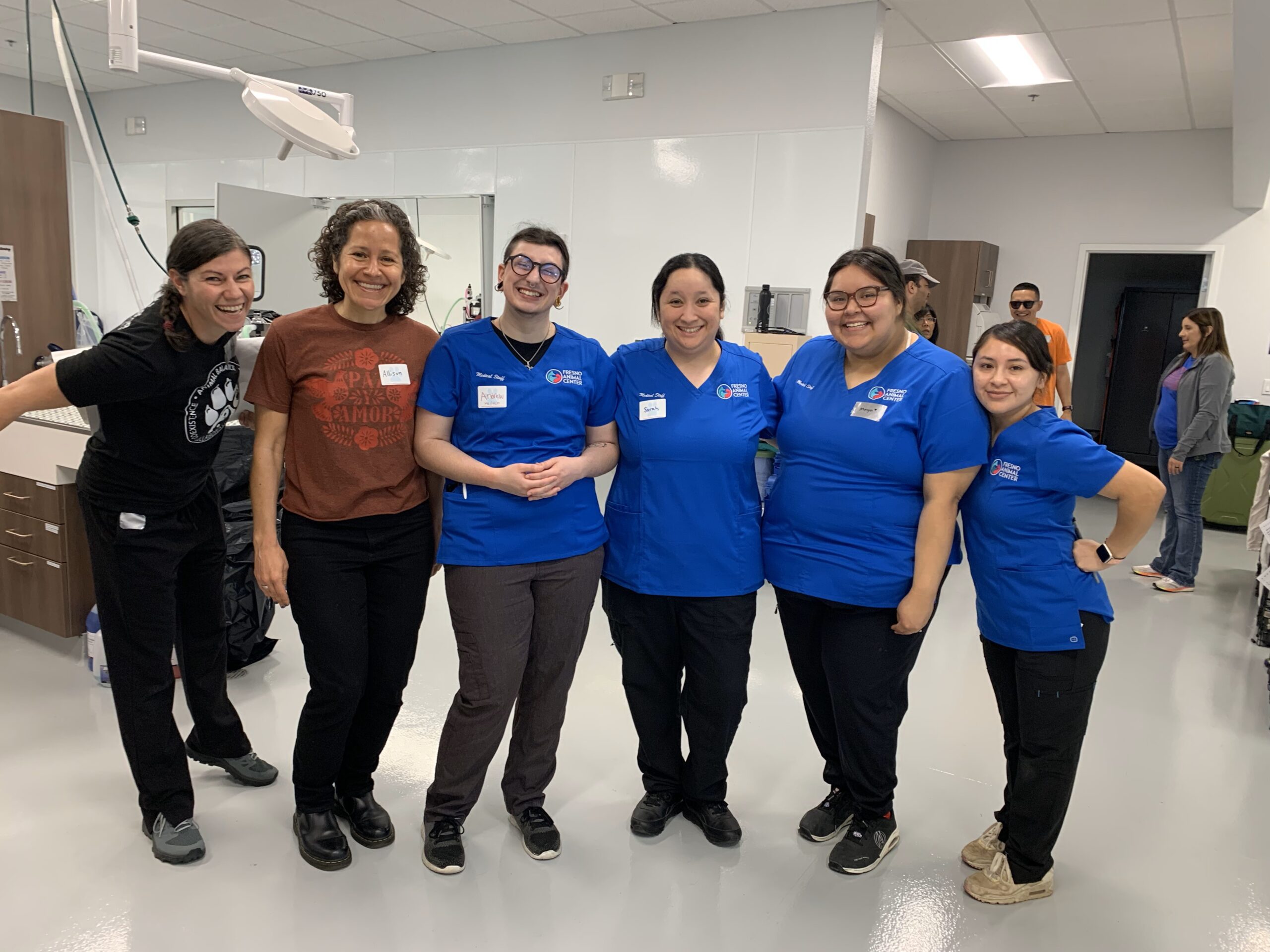
    California for All Animals’ Allison Cardona joined Megan Gram, Animal Balance Director of the Pacific Region, and Fresno Animal Center team members Andrew, Sarah, Maya, and Bede, on the first day of the Fresno Animal Center + Animal Balance Spay/Neuter Clinic.

    We’ll need partnerships like these to weather 2024 together. Economic hardship and housing insecurity will continue to strain pet owners’ ability to care for their pets. We see animal shelters making the shift to providing resources, support, and connection to services so pet owners are empowered and supported to care for their pets. Collaboration and integration between animal shelters and human services is going to be a game changer in 2024.

    Stay tuned for more grant impact news—and more grants—in the new year.

  • Announcing the More Pets and People Together Statewide Contest Winners

    Announcing the More Pets and People Together Statewide Contest Winners

    Announcing the More Pets and People Together Statewide Contest Winners

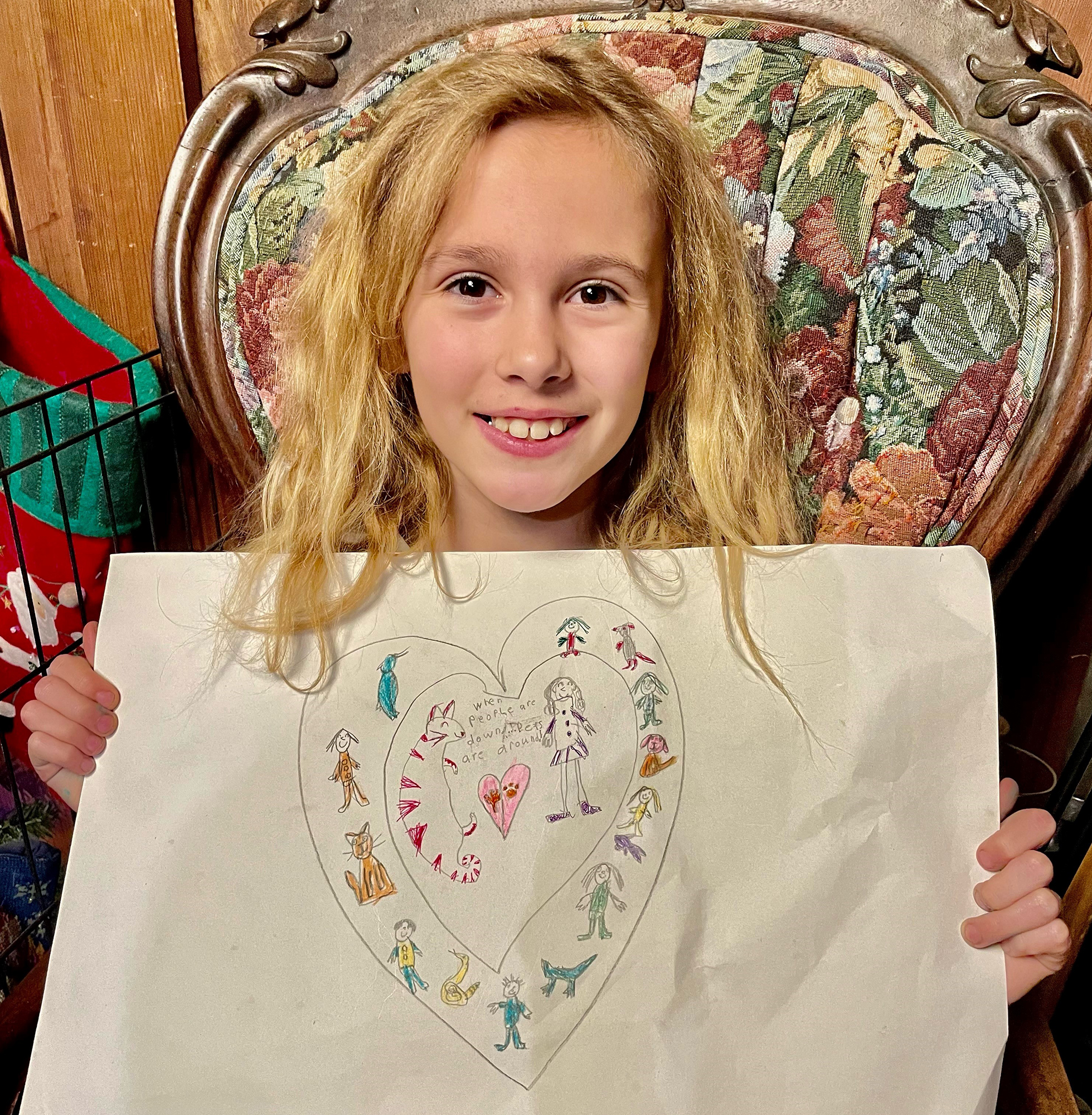
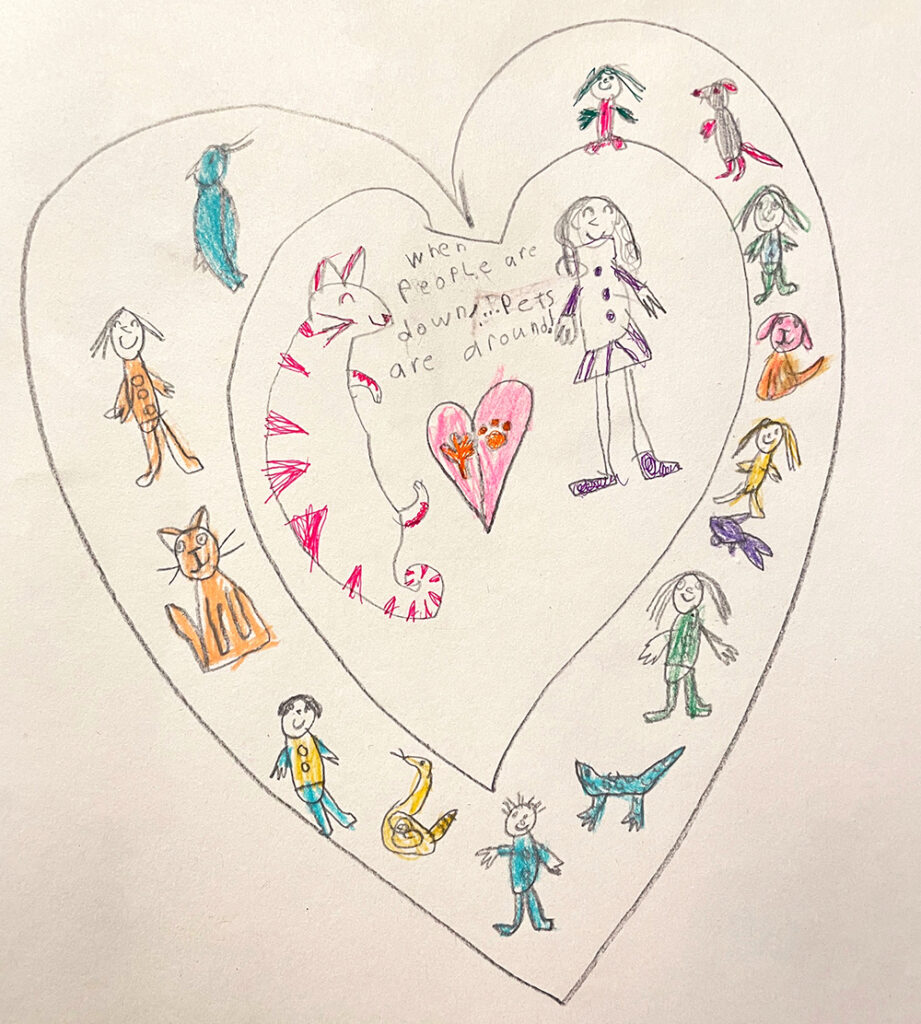
    Californians of all ages were invited to join the More Pets and People Together campaign and reflect on what animal companionship means to them and to their community via pencil, crayon, brush, or digital drawing tool, all for a chance to win a $5,000 grant for their animal shelter. The results are in, and we couldn’t choose just one winner. Congratulations to Scarlett Bispo and Uta M.!


    Art by Scarlett Bispo

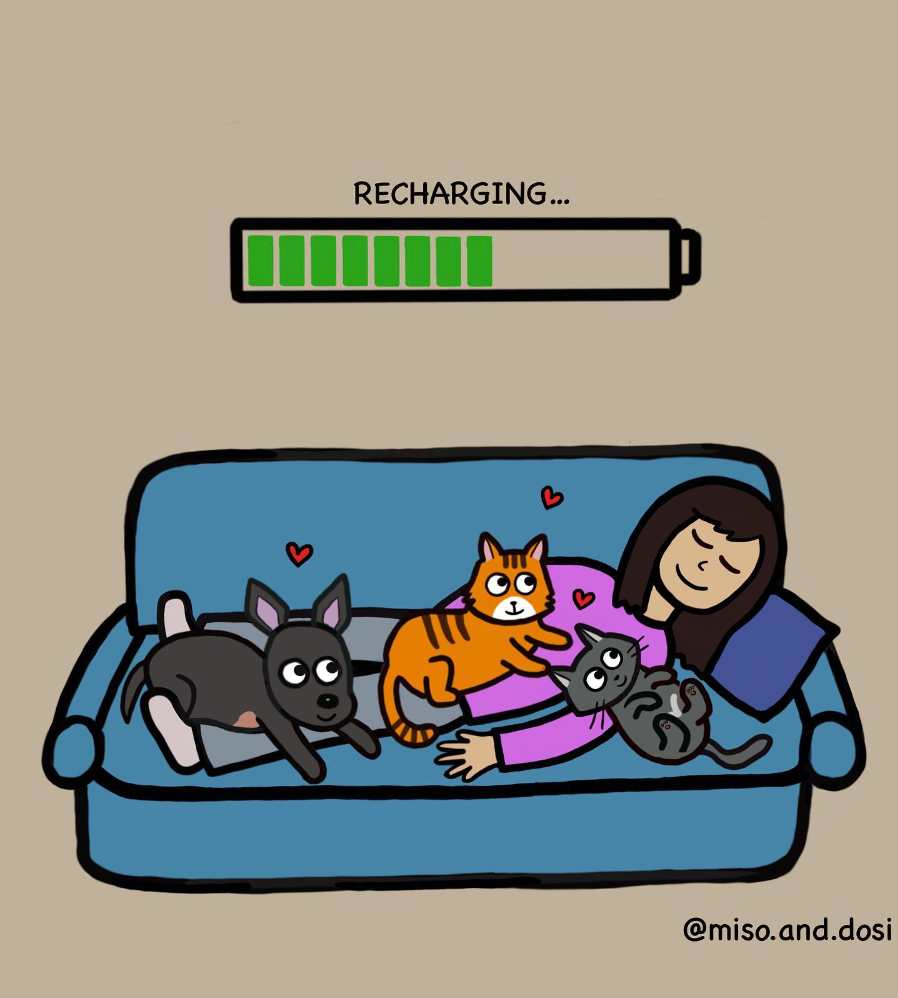
    More Pets and People Together, More Recharging - 2nd place contest winner by Uta M. is a comic depicting a woman resting happily on her couch with two cats and a dog

    Art by Uta M.

    More Pets and People Together, No Pets at the Shelter

    Acting as judges, California for All Animals Advisory Council members fell in love with each entry, but they especially appreciated eight-year-old Scarlett’s positive vision. Council member Geraldine D’Silva noted the way it invited her to see the world—and the animals and people in it—through a new perspective.

    “I put myself in the mind of an eight-year-old child trying to express my love for the human-animal bond and more pets and people together in every little stroke of the pencil to create those wonderful drawings of different animals,” she said.


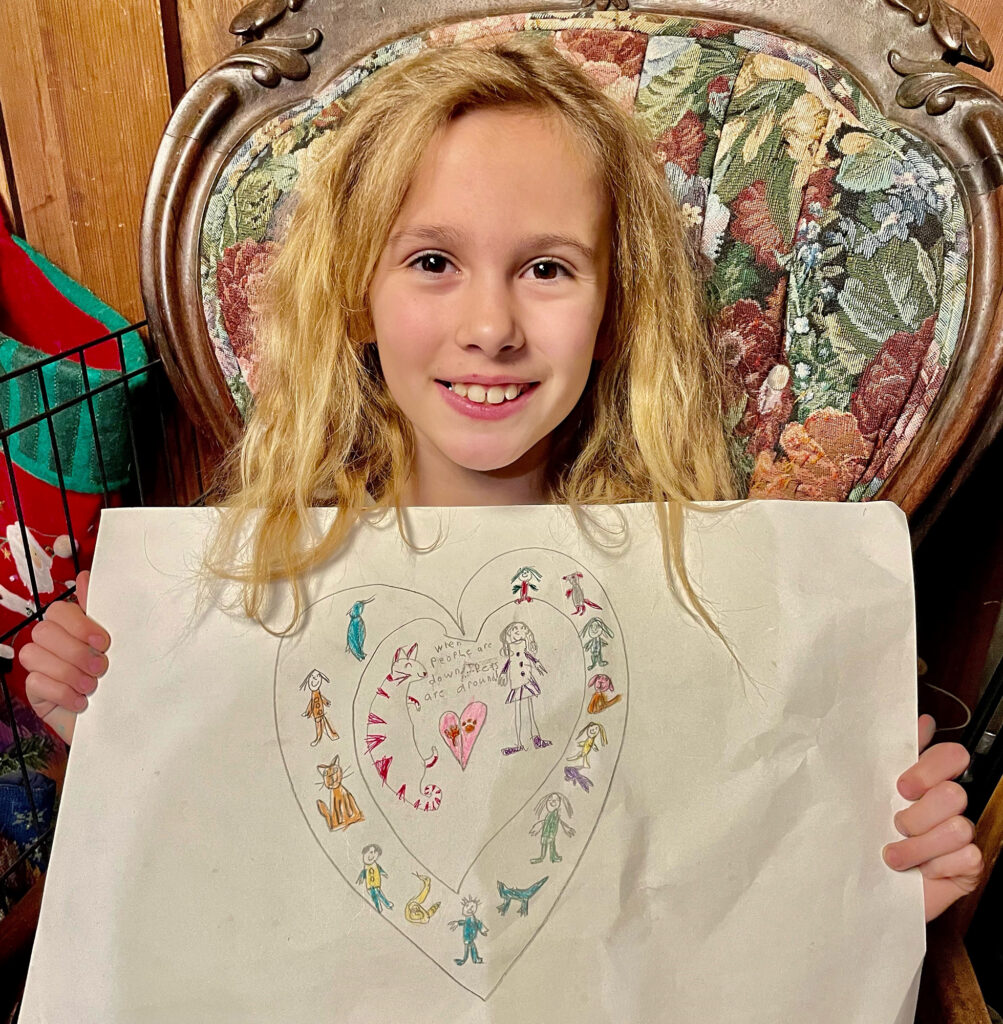
    More Pets and People Together contest winner Scarlett Bispo with her art

    When you give a helping hand, you always get one back. Like when you adopt a pet from the shelter, you get joy out of it.

    Artist Scarlett Bispo

    Scarlett said that to show togetherness she chose to alternate pets and people in equal number, with a pet for each person and a person for each pet. In the past, she’s raised money at a crafts fair to benefit her local shelter, Hitchcock Road Animal Services, and she’s excited they’ll get extra support from the grant prize.

    “When you give a helping hand, you always get one back,” Scarlett said. “Like when you adopt a pet from the shelter, you get joy out of it. I feel amazing that so many animals will be helped, and like I moved up another notch in my life and I feel confident that I can help more people and animals!”

    More Pets and People Together, More Recharging

    Council member Megan Conn admired the way second place winner Uta M.’s entry captured the spirit of the human-animal bond.

    “Our pets help us relax and get cozy, reduce stress, relieve loneliness and teach us unconditional love,” she said. “And we too have the capacity to positively affect the lives of animals by showing them kindness. We are better together!”

    Uta’s goal was to capture the power of this connection.

    “Nothing recharges the soul like quality time with pets at the end of a long day. When people and animals come together, our hearts become open to giving and receiving so much love. With everything that is going on in the world right now, this is the kind of soothing and connection that we all need in our lives.”

    She’s happy to award her grant prize to Oakland’s East Bay SPCA.

    “We adopted our chunky orange tabby boy Miso (formerly Dynamite) from [them]. Even though it was a busy holiday season and the shelter was packed, all of the staff (from the animal care associates to the front desk receptionists) were super knowledgeable about Miso and shared cute stories about his personality, clearly committed to finding his best match. They even went the extra mile to find a hard carrier for us because they worried he would fall right through a standard cardboard carrier!”

    For Uta, it’s important to support pets and people and shelters like the East Bay SPCA who keep and bring them together. Her message to the East Bay SPCA team: “Thank you for a wonderful adoption experience, and thank you for all that you do every day to give animals a life of love and hope.”

    When people and animals come together, our hearts become open to giving and receiving so much love. With everything that is going on in the world right now, this is the kind of soothing and connection that we all need in our lives.

    Artist Uta M.


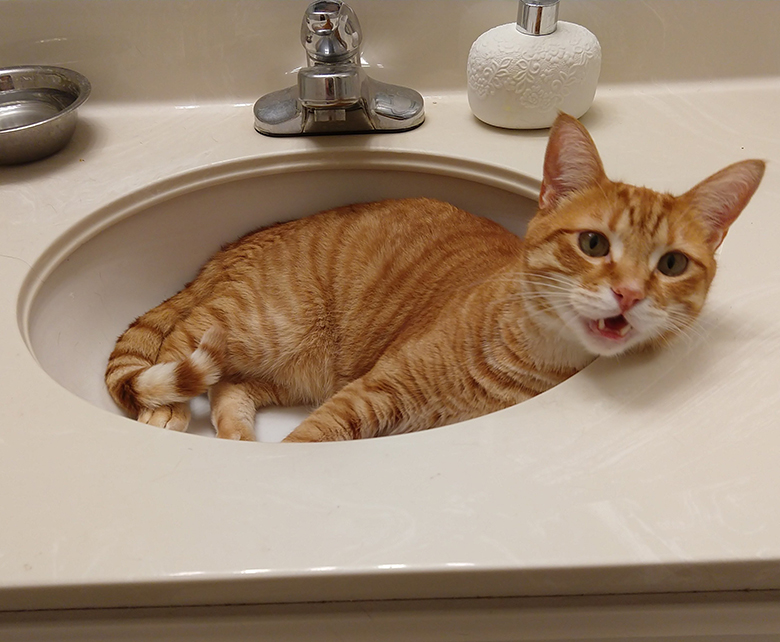
    A cat named Miso

    Uta’s cat Miso

    All people have connections with their pets

    For council member Sheila Donya Kouhkan, reviewing contest entries reaffirmed Californians’ commitment to the animals in their lives.

    “One thing that struck me as I viewed all of the beautiful art was the wide range of submissions from people of varying ages and artistic styles. It shows that all people have connections with their pets and everyone feels and deserves the loving companionship of animals. I also greatly appreciated how the art shares a glimpse into the intimate lives of people and their beloved pets behind closed doors. Pets are truly family.”

    Visit the contest page to view the full collection of entries. If you’re inspired to share what more pets and people together means to you, post your art and give your shelter a shoutout on social media with the hashtags #PetsandPeopleTogether #MascotasYPersonasUnidas.

    To learn more about how you can help keep and bring more pets and people together in your community, start here: 5 things you, your community group, business, shelter, organization, or community can do.


    More Pets and People Together main page


    Back to top

  • More Pets and People Together, More Unity

    More Pets and People Together, More Unity

    More Pets and People
    Together…


    …more
    Unity

    Three Questions That Gave Me Courage to Change

    As part of our More Pets and People Together campaign, we’re asking community members inside the shelter and out, “What do communities look like when we’re stronger side by side? What does More Pets and People Together mean to you?” Together we’re envisioning and creating communities that keep and bring pets and people together, places rooted in mutual care, joy, and connection, where everyone belongs.

    RVT and former shelter manager Ivy Ruiz reflects on what gave her courage to positively disrupt the status quo when change didn’t seem possible.

    As a shelter manager, I kept my office doors open—one led to the public lobby and another to the front office—but this time I shut them both. I had to melt down where no one could see, in the comfy chair next to the bowl of peppermint patties that everyone set aside, next to the clock that ticked all day but never got the time right. I brought my knees to my chest, buried my face, and cried.

    That afternoon, a woman had walked into the shelter to reclaim her dog, a Chihuahua Terrier mix, and staff explained the policy: if she couldn’t pay the reclaim fees, her dog would have to stay at the shelter. When I was pulled in as the supervisor, I could only say the same.

    I thought I knew what would happen next, because it happened again and again. People would make it all the way across town to reclaim their pets, sometimes by taxi, bicycle, borrowed car, or even by foot. Like other shelters, ours was on the outskirts, far from any bus stop. But without enough money to pay the fees—which accumulated quickly to hundreds of dollars and could include daily boarding fees, civil penalties, impound, license, and vaccine fees, all set at the city level—folks would have to leave empty-handed.

    Sometimes they would threaten me or another staff member, or throw pens or clipboards at the glass between us. We were on the other side of the desk, but we felt the same emotions: anger that things couldn’t be different, frustrated that we were caught in the middle, sad that people in our community thought we were heartless.

    Who could blame them? Often it felt like we were holding their dear family member hostage.

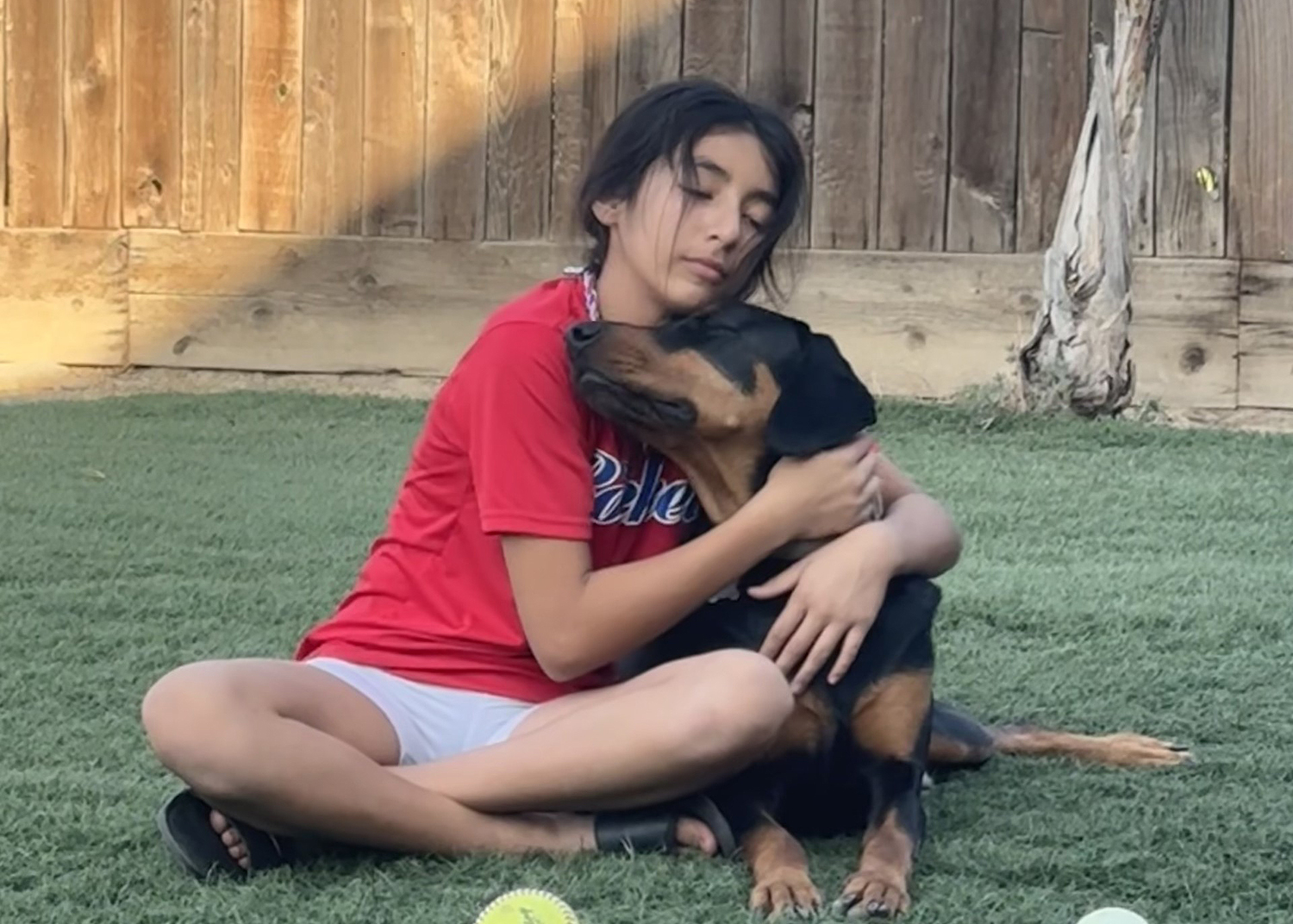
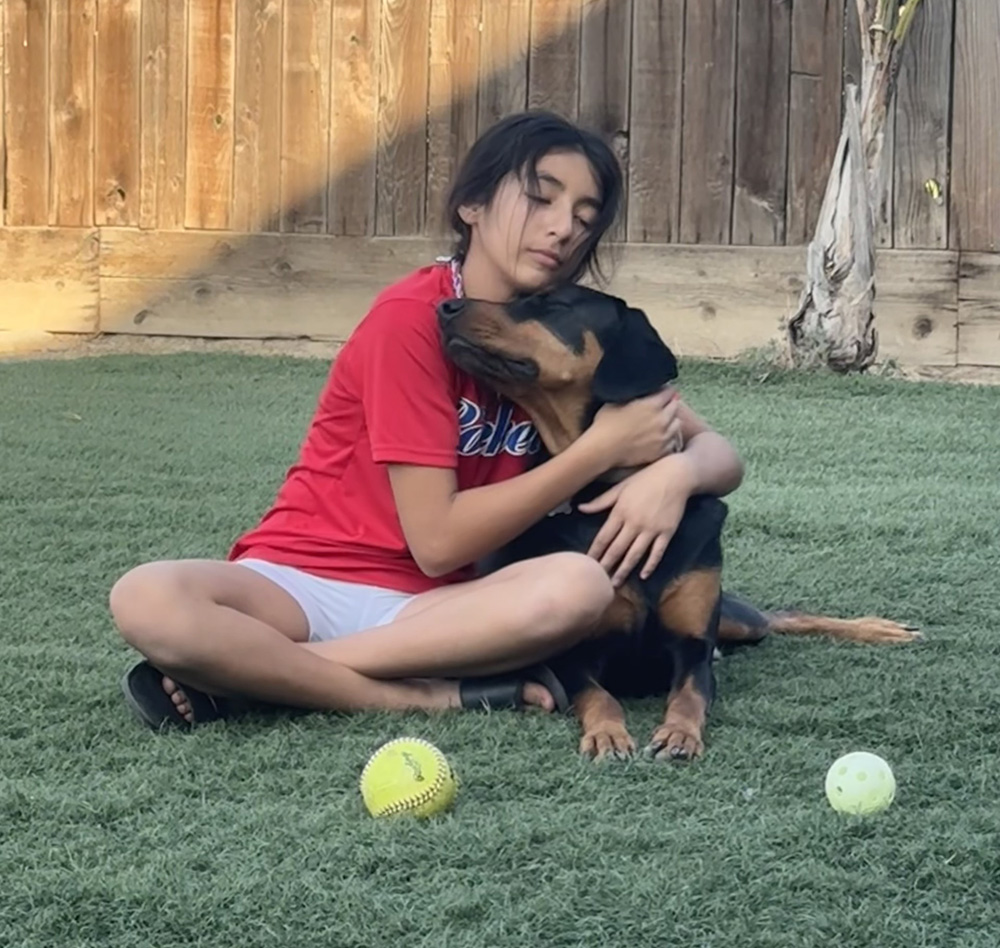
    Ivy Ruiz's daughter Xani hugs her dog Renzo

    Ivy’s daughter Xani hugs her dog Renzo

    If we weren’t sending a pet home with their family, that meant more nights waiting at our facility, putting that pet and others at risk of disease, and causing families like this one a great deal of pain and trauma.

    Ivy Ruiz

    But when I told the woman she couldn’t take her dog home, she didn’t get angry. She cried. She pleaded. “I’m a single parent with three kids,” she said. “I’m doing my best.”

    She refused to let me or this policy define her or her pet’s destiny. These fees were created for a family with double her income, she said, with a salary more than minimum wage. And if her family didn’t exactly fit that mold, it didn’t mean that they were less deserving of bringing their dog home.

    My heart broke and kept breaking in my office after she left without her dog, because she was right: There is no such thing as being too poor to love pets. Ours wasn’t an affluent community—even families with two incomes struggled. Her dog would wait at our shelter for several days or even weeks while fees continued to add up, until the only option for her and all the folks in the same situation was to surrender their pet permanently to the shelter, because that fee was more affordable than taking them back to the home they knew. 

    I was tired of setting community members, animals, our shelter and my staff up for failure. If we weren’t sending a pet home with their family, that meant more nights waiting at our facility, putting that pet and others at risk of disease, and causing families like this one a great deal of pain and trauma. It also meant higher costs to house, feed and care for animals who already had homes—and people who missed them and loved them the way they wanted to be loved. Despite all this, city officials refused to change a policy that, in their eyes, generated revenue.


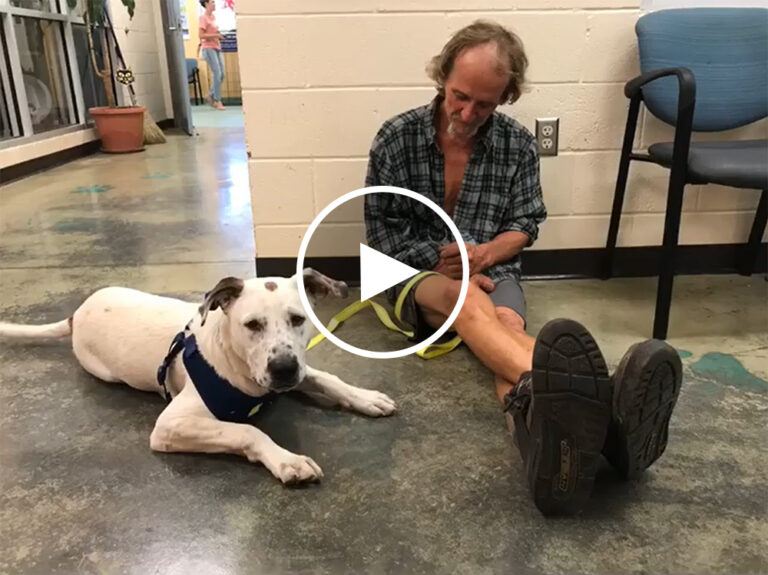
    Anthony was reunited with his best friend Bobo

    This powerful video from Memphis Animal Services shows the magic that happens when best friends reunite—and why fees shouldn’t stand between them.

    My office clock ticked on, adding up all the harm I’d caused by enforcing fees and policies designed years ago, ones that no longer—or had never—served my community. Watching this play out with family after family harmed me too. It strained my mental health and made it harder to see clearly or feel empathy.

    I opened my door and asked the front office assistant to call the woman back and tell her she could pick up her dog, no cost. The minute he saw her, he whimpered and wagged his tail. She kneeled down, and the dog came running.

    My staff and I never looked back. Sometimes we could waive all fees without drawing attention, sometimes we could waive partial fees, and sometimes we couldn’t waive any, which is when we would scramble to cover the tab. If we had to chip in to get a pet home, we did.

    It’s been years since I sat in that office, afraid of putting my job on the line by going against a policy I’d been told to follow and deciding, again and again, to do it anyway. Today, more and more shelters are fighting against unfair and ultimately unsuccessful policies and winning. They are positively disrupting systems that don’t serve anyone. At the time, I knew if I couldn’t find the courage to do what was right moving forward, I’d have to find the courage to leave this profession.

    My window faced the public parking lot, but that first afternoon as I waited for courage, I didn’t notice the woman in her car, waiting too. She’d stayed in the lot the whole time; staff told me later. Maybe some part of her was unable or unwilling to leave, not without her dog.

    Instead, I watched a nest that, one spring, a mama bird had built for her babies. Each year, sometimes twice, the birds returned to the comfort and safety they’d found in that spot.

    Instead, I was asking myself the questions I want to ask you now.

    Why can’t the shelter offer the same sense of comfort and safety for all people in our community?

    What if communities refused to set expensive reclaim fees—or changed them—knowing that most of us would not be able to afford them?

    What if, together, we refused to lose sight of what pets mean to their people?


    Read more about what we can all do to rethink reclaim fees and help pets get back home.

    Ivy Ruiz holds her dog and smiles
    Ivy Ruiz joined the UC Davis team as the new Outreach Specialist for the Koret Shelter Medicine Program in September 2022. Ivy has a long history in shelter care and medicine; she is a Registered Veterinary Technician who has worked in high-capacity shelters in California. Her passion for animals led her to a position as a Superintendent for the City of Visalia’s Animal Services Department where she trained her team to create change that would dramatically improve animal save rates in the city.

    More Pets and People Together main page


    Back to top

  • Cinco cosas que pueden hacer las ciudades y los condados

    Cinco cosas que pueden hacer las ciudades y los condados

    Aquí hay cinco maneras en que los representantes electos y los líderes públicos pueden ayudar a construir comunidades que incluyan más a las mascotas y a las personas: lugares más divertidos, justos y bienvenidos a los que todos podamos llamar hogar

    A escala nacional, el 54% de los perros entran como ” callejeros ” y menos de la mitad se reúnen con sus familias. Históricamente, los municipios y los refugios de animales se han basado en tarifas muy caras para desanimar a los miembros de la comunidad a dejar que sus perros se paseen, pero un sistema punitivo crea barreras entre los dueños de mascotas en dificultades y las organizaciones de cuidado de animales que podrían ayudarles. Las multas y las tasas no cambian el comportamiento de un animal ni arreglan una cerca rota, pero pueden suponer la diferencia entre que una mascota se vaya a casa o se quede en el refugio, lo que en última instancia aumenta el costo de la atención en el refugio y contribuye al exceso de animales, poniendo en riesgo a la población general del refugio. Como las adopciones no van a la par de los perros que entran en los refugios, la duración de la estancia aumenta y el impacto fiscal en el refugio crece cada día.

    Considere la posibilidad de analizar las tarifas para determinar lo que los miembros de su comunidad pueden pagar de forma realista. Si el código de su condado o municipio no permite que los refugios reduzcan o eliminen las tarifas cuando sea necesario para que las mascotas vuelvan a casa, trabaje con los refugios locales y la comunidad para cambiarlo.

    Es especialmente importante apoyar iniciativas que refuercen la capacidad veterinaria y amplíen el acceso a la esterilización: Entre los muchos beneficios, la esterilización anima a las mascotas a quedarse cerca de casa, lo que aumenta su seguridad y disminuye el número de perros y gatos que andan por las calles. Pero cuando la cirugía de esterilización tuvo que suspenderse durante la pandemia, nos quedamos casi tres millones de cirugías por detrás de lo que se habría logrado normalmente. La falta de veterinarios y enfermeras veterinarias en todo el país está haciendo aún más difícil cubrir las necesidades, y mucho más recuperar el déficit, que se agrava en las comunidades que ya no tienen atención veterinaria asequible ni veterinarios.

    Es más importante que nunca garantizar que todos los residentes de la comunidad y los grupos de TNR tengan acceso a la esterilización/castración de animales. Los líderes de la comunidad están trabajando juntos para conseguirlo. Por ejemplo, gracias al Fondo de Mejora de la Comunidad de Rancho Cordova, el Consejo Municipal de Rancho Cordova colabora con los Servicios para Animales de Rancho Cordova, el Condado de Sacramento y organizaciones como Whisker Warriors para ofrecer a los residentes esterilizaciones gratuitas o a bajo costo, licencias gratuitas para mascotas, TNR para gatos de la comunidad y suministros de alimentos para mascotas.

    Con demasiada frecuencia, los californianos sin hogar o víctimas de la violencia doméstica no pueden conseguir una vivienda temporal o de emergencia porque dejarían atrás a sus queridos animales de compañía. El 34.9% de las mujeres y el 31.1% de los hombres de California han sufrido violencia física, sexual y/o acoso por parte de su pareja durante su vida. Según el informe 2023 de la Alianza Nacional para Acabar con la Falta de Vivienda, los californianos tienen la mayor probabilidad de no tener vivienda, 44 de cada 10,000 residentes, con más de 170,000 personas sin hogar en el estado. El co-refugio -definido por My Dog Is My Home como el refugio de personas y animales juntos en la misma instalación de emergencia o de vivienda temporal- permite que las personas y las mascotas permanezcan juntas mientras buscan un refugio seguro. Las organizaciones de atención a los animales y las organizaciones de servicios sociales trabajan juntas para llevar el co-refugio a sus comunidades. Obtenga más información sobre el co-refugio y únase a Co-Sheltering Collaborative en https://www.mydogismyhome.org/.

    En California, 35 millones de mascotas residen en más de la mitad de los hogares, y los problemas de vivienda o con el dueño se encuentran entre las razones más comunes para la entrega de mascotas. Mientras las ciudades colaboran para hacer frente a la crisis de la vivienda en todo el estado, debemos garantizar que todos los propietarios de mascotas puedan acceder a viviendas seguras y asequibles. Aunque ahora se aplican protecciones a los californianos que residen en viviendas financiadas por el Departamento de Vivienda y Desarrollo Comunitario de California, muchos más inquilinos californianos, si pueden encontrar una vivienda que incluya mascotas, se enfrentan a restricciones de raza o peso o a depósitos no recuperables o a pagos mensuales de alquiler de mascotas.

    Para obtener más datos y soluciones basadas en el mercado que podrían garantizar el acceso a una vivienda segura y asequible para personas y mascotas en su comunidad, visite la Iniciativa de Vivienda Inclusiva para Mascotas. Para hacerse una idea de cómo va su región en la creación de políticas inclusivas para mascotas, visite el National Rental Research Dashboard.

    Los refugios de animales, los veterinarios y los proveedores de servicios sociales y de salud humana reconocen que la salud y el bienestar de las personas y los animales están interconectados: las personas que se enfrentan a barreras sistémicas y discriminación estructural también sufren la falta de acceso a recursos, servicios y oportunidades para cuidar de sus mascotas. Un enfoque holístico de Una Salud reconoce la conexión entre la salud de los animales, las personas, las plantas y el medio ambiente, y asigna fondos y diseña políticas y servicios en este sentido.

    Apoye a los refugios de animales y a las agencias de servicios para animales a pasar de un modelo que prioriza la entrega a un modelo que prioriza la prevención y el apoyo y que se centra en mantener a los animales en sus hogares. Para obtener más información sobre el impacto de las relaciones entre humanos y animales en el bienestar general de la comunidad y leer las recomendaciones estratégicas de California for All Animals para resolver los problemas urgentes a los que se enfrentan los refugios de animales, visite los siguientes recursos:

    ¿Qué son las tarifas de reclamación de refugio (también llamadas tarifas de vuelta al dueño o de recuperación)?

    Cuando una mascota encontrada en la calle se asuma perdida y es llevada al refugio por agentes de servicios para animales o miembros de la comunidad, es probable que los dueños tengan que pagar tarifas de recuperación y, potencialmente, multas civiles para recuperar a su mascota. Estas tarifas se fijan a nivel municipal o del condado, sin que los refugios puedan decidir si las eliminan o las reducen. Dependiendo de las circunstancias, un dueño puede enfrentarse a una costosa factura para recuperar a un perro que se escapó de un patio o que simplemente estaba visitando a un amigo de la calle. Junto con el transporte, el idioma y otras barreras, las caras tarifas de recuperación pueden impedir que las mascotas vuelvan con sus familias y son una de las razones por las que menos de la mitad de los perros y menos de 1 de cada 20 gatos son recuperados en los refugios de todo el país.

    Puedes ayudar a que las tarifas no se impongan entre las mascotas y las personas que las quieren ayudándole a volver a casa en lugar de llevarla al refugio, creando o donando al fondo de regreso a casa de un refugio, y uniéndote a tu refugio para defender su capacidad de reducir o eliminar las tarifas con el fin de reunir a las mascotas con sus familias.


    Más mascotas y personas unidas


    Volver arriba

  • Cinco cosas que pueden hacer las empresas

    Cinco cosas que pueden hacer las empresas

    Los clientes son fieles a las marcas que comparten sus valores y que retribuyen a sus comunidades. Aquí tienes cinco maneras de #AyudaHoy para unir a mascotas y personas, al tiempo que te unes en tus valores compartidos.

    Su negocio ya es una parte fundamental de su comunidad: todo lo que necesita es un escáner de microchip para ser una parada única para mantener a las mascotas y a las personas unidas y abrir sus puertas a nuevos clientes. También puede ofrecerse a imprimir folletos sobre mascotas perdidas.

    ¿Por qué es importante esto? Las mascotas sueltas no siempre están perdidas: los estudios han demostrado que la mayoría de los perros sueltos se encuentran a menos de un kilómetro y medio de sus casas y muchos a menos de una cuadra. Lo más probable es que un gato que parece sano y en buen estado sea una mascota de interior o exterior o un gato de la comunidad cuidado por una red de vecinos. Cuando las mascotas encontradas son llevadas a los refugios, menos del 20% de los perros sueltos y sólo el 5% de los gatos a nivel nacional son reclamados por un dueño; cuando una mascota puede permanecer segura en el vecindario donde fue encontrada, sus posibilidades de reunirse con su familia aumentan significativamente. La mejor manera de asegurarse de que una mascota sana y amistosa vuelve a casa es empezar por buscar una placa de identificación, publicarla en las redes sociales, preguntar a los vecinos cercanos y buscar un microchip. Más información sobre cómo ayudar a un perro, gato o gatito encontrado.

    Es fácil convertirse en una estación de escaneo de microchips, al igual que las personas y empresas que forman parte del programa Pet Pals del Refugio de Animales Chico. Hable con su refugio para formar un equipo.

    Si su organización tiene un espacio de reunión, o usted es un dueño que tiene espacio no utilizado, considere la posibilidad de colaborar con refugios y organizaciones de adopción para mostrar mascotas que necesitan nuevos hogares y reunir a más mascotas y personas. También puede ayudar a promocionar mascotas adoptables compartiendo publicaciones a través de sus cuentas en las redes sociales o mediante el periódico del grupo.

    Consulte a las organizaciones locales de refugios, servicios humanos y cuidado de animales para averiguar qué es lo que más necesitan las familias y las mascotas y las organizaciones que trabajan con ellas. Algunas empresas han organizado una recolecta de alimentos y suministros para mascotas; han juntado jaulas, mantas o ropa de cama; han recogido donativos para ayudar con los gastos de esterilización, atención veterinaria o las tasas que la gente tiene que pagar para recuperar a sus mascotas perdidas; o han creado y publicado listas de la compra en Internet para las organizaciones. También puedes buscar cerca de ti un sitio de donaciones que distribuya artículos para el cuidado de mascotas a personas sin hogar y sus mascotas, o pensar en convertirte en un sitio proveedor de alimentos para mascotas si no existe ninguno en tu comunidad.

    Establezca relaciones con otras organizaciones y personas de su comunidad asociándose con su centro de refugio local para organizar una clínica de vacunación, una campaña de colección de fondos o cualquier otro acto comunitario.

    Cuando las mascotas y las personas tienen acceso a los recursos que necesitan para prosperar, nuestras comunidades florecen, y eso es bueno para los negocios. Al igual que para construir una casa sólida se necesitan personas y materiales diversos, construir y mantener el bienestar de las personas y los animales de compañía en su comunidad depende de que muchas personas trabajen juntas. Hable con los representantes electos de su ciudad y condado sobre la importancia de permitir que los refugios no cobren o reduzcan las tarifas para que recuperar una mascota perdida o adoptar una nueva sea asequible para todos. Haga énfasis en la urgencia de financiar personal y programas que hagan frente a las graves deficiencias de nuestro sistema de atención, de modo que podamos ofrecer a las personas y a los animales domésticos el apoyo que necesitan para estar mejor juntos.

    Es especialmente importante apoyar iniciativas que desarrollen la capacidad veterinaria y extiendan el acceso a la esterilización/castración. Cuando la cirugía de esterilización tuvo que suspenderse durante la pandemia, nos quedamos casi tres millones de cirugías por detrás de lo que normalmente se habría logrado. La falta de veterinarios y enfermeras veterinarias en todo el país está dificultando aún más la cobertura de las necesidades, y mucho más la recuperación del déficit, que se agrava en comunidades que ya no tenían atención veterinaria asequible ni veterinarios.

    También puede solicitar fondos para clínicas móviles, grupos comunitarios de esterilización/castración de gatos, o para ayudar a los refugios de animales locales y organizaciones asociadas a garantizar que podamos renunciar o reducir las tarifas que se interponen entre las mascotas y las personas y ofrecer recursos y servicios esenciales -como clínicas de vacunación y servicios de esterilización/castración de bajo costo que mantienen unidas a las personas y las mascotas de nuestra comunidad.

    Para más información sobre estas y otras formas de hacer la diferencia, visite petsandpeopletogether.org.

    ¿Qué son las tarifas de reclamación de refugio (también llamadas tarifas de vuelta al dueño o de recuperación)?

    Cuando una mascota encontrada en la calle se asuma perdida y es llevada al refugio por agentes de servicios para animales o miembros de la comunidad, es probable que los dueños tengan que pagar tarifas de recuperación y, potencialmente, multas civiles para recuperar a su mascota. Estas tarifas se fijan a nivel municipal o del condado, sin que los refugios puedan decidir si las eliminan o las reducen. Dependiendo de las circunstancias, un dueño puede enfrentarse a una costosa factura para recuperar a un perro que se escapó de un patio o que simplemente estaba visitando a un amigo de la calle. Junto con el transporte, el idioma y otras barreras, las caras tarifas de recuperación pueden impedir que las mascotas vuelvan con sus familias y son una de las razones por las que menos de la mitad de los perros y menos de 1 de cada 20 gatos son recuperados en los refugios de todo el país.

    Puedes ayudar a que las tarifas no se impongan entre las mascotas y las personas que las quieren ayudándole a volver a casa en lugar de llevarla al refugio, creando o donando al fondo de regreso a casa de un refugio, y uniéndote a tu refugio para defender su capacidad de reducir o eliminar las tarifas con el fin de reunir a las mascotas con sus familias.


    Más mascotas y personas unidas


    Volver arriba

  • Cinco cosas que pueden hacer los grupos comunitarios

    Cinco cosas que pueden hacer los grupos comunitarios

    Los grupos religiosos, juveniles, cívicos y otros grupos comunitarios pueden #AyudarHoy aprovechando el poder de su gente para asegurarse de que las mascotas puedan pasar más noches en casa, no en refugios.

    Póngase en contacto con el refugio de animales de su localidad, con grupos comunitarios de esterilizar a gatos, con servicios sociales y otras organizaciones de atención a los animales para averiguar qué es lo que más necesitan las familias y los animales de compañía y las organizaciones que trabajan con ellos. Algunos grupos han organizado una campaña de recolección de alimentos y suministros para mascotas; han juntado jaulas, mantas o ropa de cama; han recogido donativos para ayudar a cubrir los gastos de esterilización o castración, los cuidados veterinarios o las tarifas para que las mascotas perdidas puedan volver a casa; o han creado y publicado listas de la compra en Internet para las organizaciones. Los Scouts y otros grupos de jóvenes han fabricado juguetes, camas e incluso han construido patios de recreo al aire libre y mejorado las viviendas de perros, gatos y otros bichos. También puedes buscar cerca de ti un sitio de donaciones que distribuya artículos para el cuidado de mascotas a personas sin hogar y a sus mascotas, o considerar la posibilidad de convertirte en un sitio proveedor de alimentos para mascotas si no existe ninguno en tu comunidad.

    Desde un lavado de coches o una venta de pasteles hasta una noche de cine o micrófono abierto, puedes ayudar a los refugios de animales y otras organizaciones de apoyo a los animales de compañía y a las personas. Algunas organizaciones se unen para planear un acto en el barrio o en toda la comunidad. Puedes recolectar fondos para clínicas móviles, grupos comunitarios de esterilización/castración de gatos, o para ayudar a los refugios de animales locales y organizaciones asociadas a garantizar que podamos renunciar o reducir las tarifas que se imponen entre las mascotas y las personas y ofrecer recursos y servicios esenciales -como clínicas de vacunación y servicios de esterilización/castración a bajo costo- que acercan y mantienen unidas a las personas y las mascotas de nuestra comunidad. Considere la posibilidad de invitar a funcionarios municipales y otros responsables de la política y exprese la importancia que tiene para su comunidad dedicar recursos a los servicios esenciales que ayudan a los animales de compañía y a las personas.

    Organice una red de personas que puedan ofrecerse voluntarias o correr la voz cuando un amigo, familiar o vecino necesite encontrar un hogar para su mascota o necesite a alguien que cuide temporalmente de ella debido a un despliegue militar, un problema médico o cualquier otra situación urgente. Su grupo también puede actuar como investigador de animales y aumentar las probabilidades de que las mascotas encontradas vuelvan a casa consultando a los vecinos de la localidad en la que se encontró a la mascota, publicando en las redes sociales sobre objetos perdidos y en páginas de la comunidad como Nextdoor, y publicando folletos sobre mascotas encontradas.

    Si su organización tiene un espacio de reunión, o usted es un dueño que tiene espacio no utilizado, considere la posibilidad de colaborar con refugios y organizaciones de adopción para mostrar mascotas que necesitan nuevos hogares y reunir a más mascotas y personas. También puede ayudar a promocionar mascotas adoptables compartiendo publicaciones a través de sus cuentas en las redes sociales o mediante el periódico del grupo.

    Al igual que para construir una casa sólida se necesitan personas y materiales diversos, para construir y mantener el bienestar de las personas y los animales domésticos se necesitan recursos comunitarios, relaciones sociales y oportunidades para prosperar. Construir el bienestar en su comunidad depende de la colaboración de muchas personas. Hable con los funcionarios electos de su ciudad y condado sobre la importancia de permitir que los refugios no cobren o reduzcan las tarifas para que recuperar una mascota perdida o adoptar una nueva sea asequible para todos. Haga énfasis en la urgencia de financiar personal y programas que aborden las lagunas de nuestro sistema de atención para que podamos proporcionar a las personas y a las mascotas el apoyo que necesitan para estar mejor juntos.

    Es especialmente importante apoyar iniciativas que desarrollen la capacidad veterinaria y extiendan el acceso a la esterilización/castración. Cuando la cirugía de esterilización tuvo que suspenderse durante la pandemia, nos quedamos casi tres millones de cirugías por detrás de lo que normalmente se habría logrado. La falta de veterinarios y enfermeras veterinarias en todo el país está dificultando aún más la cobertura de las necesidades, y mucho más la recuperación del déficit, que se agrava en comunidades que ya no tenían atención veterinaria asequible ni veterinarios

    Para más información sobre estas y otras formas de hacer la diferencia, visite petsandpeopletogether.org

    ¿Qué son las tarifas de reclamación de refugio (también llamadas tarifas de vuelta al dueño o de recuperación)?

    Cuando una mascota encontrada en la calle se asuma perdida y es llevada al refugio por agentes de servicios para animales o miembros de la comunidad, es probable que los dueños tengan que pagar tarifas de recuperación y, potencialmente, multas civiles para recuperar a su mascota. Estas tarifas se fijan a nivel municipal o del condado, sin que los refugios puedan decidir si las eliminan o las reducen. Dependiendo de las circunstancias, un dueño puede enfrentarse a una costosa factura para recuperar a un perro que se escapó de un patio o que simplemente estaba visitando a un amigo de la calle. Junto con el transporte, el idioma y otras barreras, las caras tarifas de recuperación pueden impedir que las mascotas vuelvan con sus familias y son una de las razones por las que menos de la mitad de los perros y menos de 1 de cada 20 gatos son recuperados en los refugios de todo el país.

    Puedes ayudar a que las tarifas no se impongan entre las mascotas y las personas que las quieren ayudándole a volver a casa en lugar de llevarla al refugio, creando o donando al fondo de regreso a casa de un refugio, y uniéndote a tu refugio para defender su capacidad de reducir o eliminar las tarifas con el fin de reunir a las mascotas con sus familias.


    Más mascotas y personas unidas


    Volver arriba