Over 800 people attended the Spring ’23 Shelter Summit live on March 14. It is now available on demand at Maddie’s® University, where you can view each of the presentations and Q&A sessions. Those presentations offered tantalizing suggestions to meet some of shelters’ greatest challenges. But change is hard. You need hope, help and time. That’s where Fast Tracks come in.
Fast Tracks are eight once-a-week, one-hour deep dives focused on implementation. The first meetings were last week, but it’s never too late to jump in. Get guidance from your coach and support from your peers in four live Zoom meetings, and pop in for optional office hours during off-weeks in April and May. Attendance at any of the meetings or office hours is optional to make it easy for you to attend what you can. Live meetings will be recorded and available on-demand shortly after each meeting ends. Fast Track participation is open to everyone, no application required. Just click on the name of the Fast Track you are interested in below and you’ll get access to all of the meetings in that track. Not sure which Fast Track(s) to attend? Watch the corresponding presentation in the Summit On Demand or read the descriptions at sheltersummit.com.
108 California organizations applied for the Open Arms Challenge this year. They spent last month preparing—updating procedures, training staff and volunteers, engaging translators to reach more people in more languages, etc.—and are implementing their welcoming practices this month.
At a recent Open Arms Office Hours call, we heard how a rescue is thinking of new ways to reach people in their communities (flyering and tabling at events, for example, instead of exclusively recruiting online) and a shelter is working to undo the bad feelings created by the unwelcoming policies they’re replacing. The next Open Arms Office Hours call is Thursday, April 27. Register here to attend and let us know how you’re doing. If you’ve encountered an unexpected challenge, maybe somebody else on the call will have already solved for that very thing. Or maybe you’ve discovered a great tactic you’d like to share with others.
Shelters and rescues will report on their initiatives in mid-May, and in September the 22 organizations sponsoring the Challenge will announce the winners of $420,000 in grants.
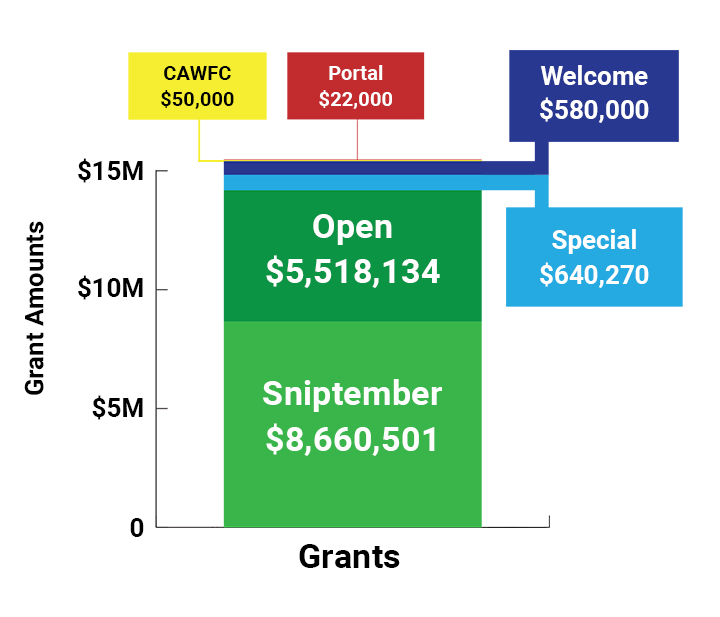
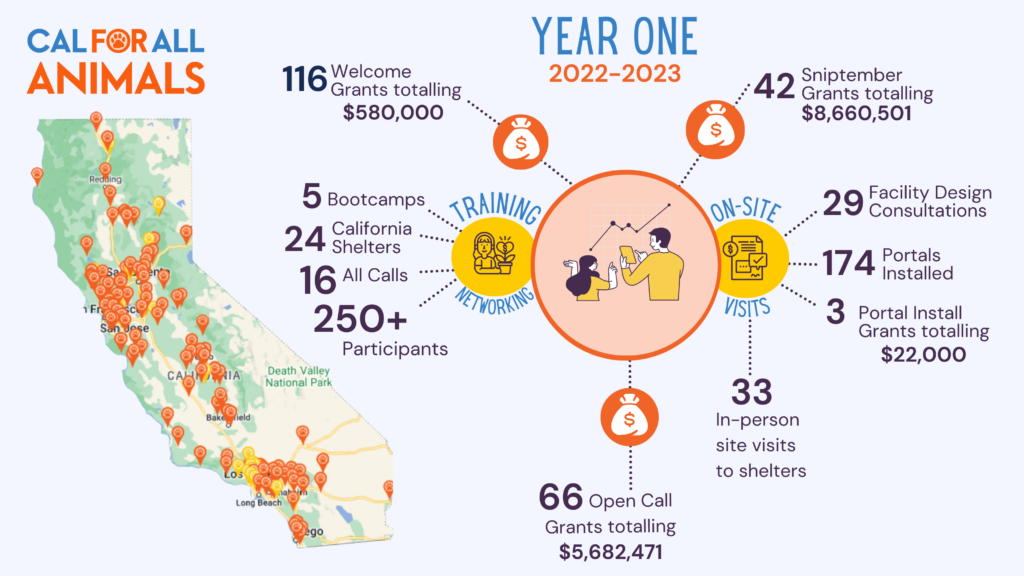
California for All Animals Distributes $15.5M in Grants in First Year
In accordance with the language set forth in Article 6.4. Animal Shelter Assistance Act, KSMP set out to design a program that provided outreach, in-person assessments, training on current best practices, and grant monies to California city, county, or city and county animal control agencies or shelters, societies for the prevention of cruelty to animals, and humane societies. The language outlined in the Animal Shelter Assistance Act served as a guide for the program and funding design. Best practices and recommendations were grounded in the Association of Shelter Veterinarian’s Guidelines for Standards of Care in Animal Shelters, of which members of the KSMP were co-authors, as well as the expertise of the team in multiple areas of animal sheltering from veterinary care and surgery to shelter management and marketing. In addition to soliciting feedback from public and private animal shelters within the state, KSMP engaged with other granting organizations and service agencies working in the state and nationally such as Maddie’s Fund, Best Friends Animal Society, American Society for the Prevention of Cruelty to Animals (ASPCA), Michelson Found Animals Foundation, RSO Foundation, California Community Foundation, PetSmart Charities, National Animal Care and Control Association (NACA), Companions and Animals for Reform and Equity (CARE), and Cal Animals. This research and stakeholder input supported the identification of best practices and the development of a strategic plan for the California for All Animals program.
The California for All Animals program publicly launched on February 14, 2022, with concerted marketing and outreach efforts designed to engage shelters in every region of the state that met the goals outlined in the Animal Shelter Assistance Act.
At a time when many families lack access to essential resources that build health and well-being for themselves and their pets, Rancho Cordova Animal Services is focused on partnering with community members to tackle barriers and create more opportunities for people and animals to thrive.
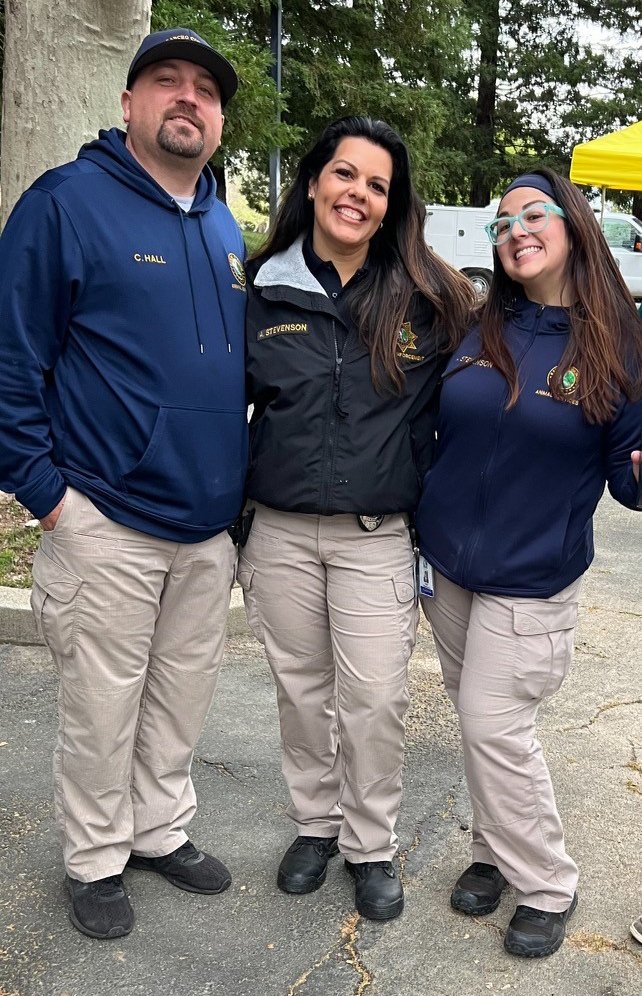
It’s the nature of the job for an animal services officer: You’re often meeting people and pets who are going through a rough spot, but that also puts you in the position to lend a hand. Navigating tricky situations to help animals and people is what drew Craig Hall, Kristy Acuna, and April Stevenson to their roles at Rancho Cordova Animal Services, and coming up against their own limitations to lend a hand is what led them to a program evolution and a new chapter for animal services in the city.
When Craig joined Rancho Cordova as Senior Animal Services Officer in 2019, he brought with him over a decade of experience and an outlook inspired by an early mentor who shaped not only his career path, but his vision for what animal services could look like: You can be a ‘dogcatcher,’ or you can be an animal services officer, he told Craig. In other words, do you want to embrace the outdated stereotype or transcend it?
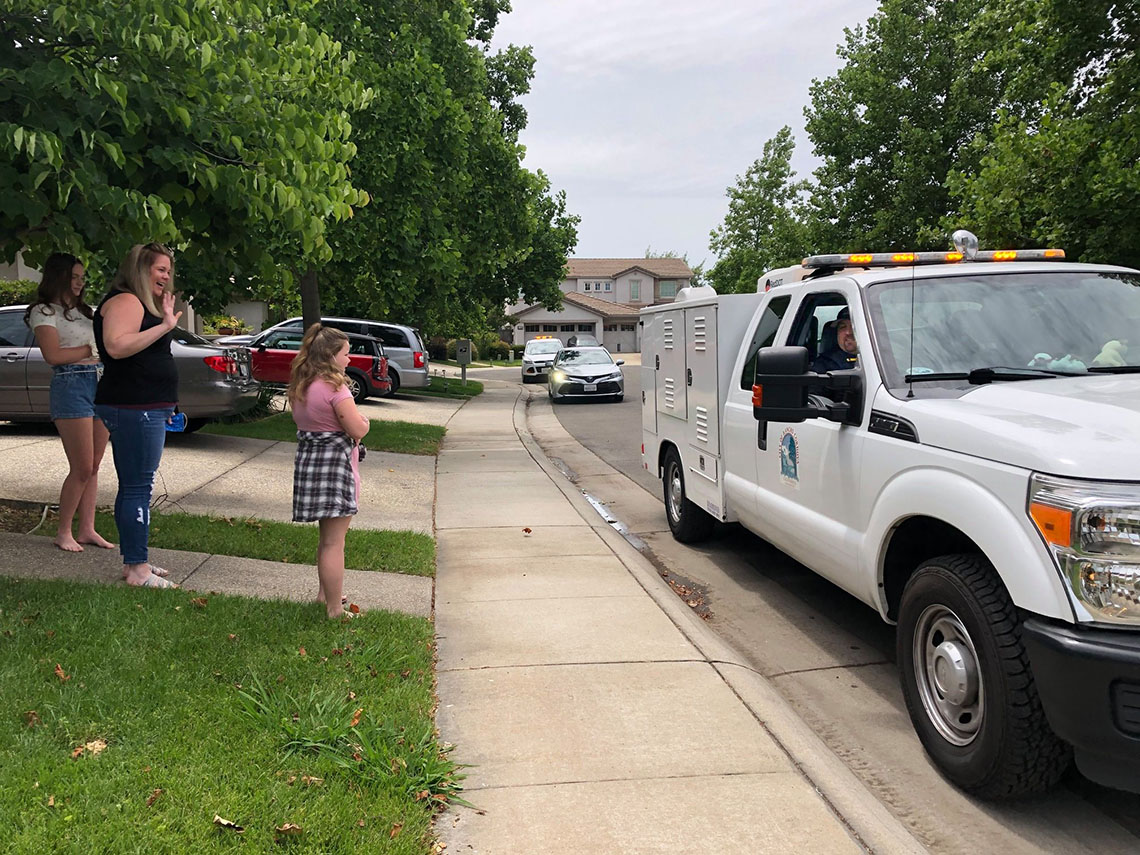
The Rancho Cordova Animal Services team focuses on building relationships in their community. In this photo, officers visit a nine-year-old girl interested in fostering a dog. (Credit: City of Rancho Cordova)
This choice cemented the mindset that guided Craig as he led the charge to modernize and grow animal services in Rancho Cordova, hiring Kristy and April. “Have integrity with everything. There’s a lot of things you can do to make your work easier, but it may not be right for the animals. It may not be right for the pet owner who needs help.”
The tipping point for the three officers was achingly ordinary, a typical scenario playing out daily in towns and cities across the state: they encountered a fellow community member in a rough spot who was unable to afford the urgent care their pet needed. In the face of nationwide veterinary shortages and rising costs for necessities like food, housing, and healthcare, it’s increasingly challenging for families to access and afford care, and animal services officers see firsthand how emergencies or illnesses can break budgets and strain already burdened families who want to do the right thing for their pets.
We were so tired of seeing the limited options for low-income pet owners.
April Stevenson
It’s not for lack of love. In this case, Kristy says, the pet “could look at his owner, and the owner could look at him, and there was a palpable feeling that they were bonded. They were connected.”
Existing protocol and resources meant the team had few options to offer beyond referrals to CareCredit, which comes with its own barriers to financing vet care. More often than not in situations like this, pet owners are faced with the best bad option: surrendering their beloved companion to the shelter and an unknown future to stop that pet’s suffering. Witnessing this outcome and its impact on the family, the animal, and the shelter play out yet again didn’t sit well with the officers.
“It felt like a punch to the stomach,” says Craig.
April agrees. “We were so tired of seeing the limited options for low-income pet owners.”
Having enough cash to cope with a crisis is a challenge that extends across income levels in the U.S., with over one-third of working adults documented as “financially fragile,” or unable to come up with $2,000 in 30 days.
The team knew additional resources could help people and pets in Rancho Cordova stay together, so they developed a plan and applied for a California for All Animals grant to make support—rather than surrender—a viable option.
Confronting barriers to spark change
While the Rancho Cordova Animal Services team had one solution to offer before, now they have many. Under their Community Support Program, lending a hand means problem-solving alongside community members and choosing from a variety of tools matched to challenges that could otherwise lead to pets leaving a home where they are already loved. The program established by Craig, Kristy, and April complements existing city programs like free spay/neuter and pet licensing.
“We’re able to fill that gap between someone saying I can’t have this animal for X, Y, Z—a solvable issue,” Craig says. “A lot of times the best situation for that animal is to stay at home, and a lot of times the owner is almost forced into a position where they have to relinquish their animal, or they feel forced, when, if we can provide a little bit of assistance, we can keep that animal at home.”
Since the program’s launch, they’ve teamed up with many families to do just that, whether by removing barriers to vet care through financial assistance, offering collapsible crates and crate training resources, or, for pets who primarily live outside, providing a pulley dog run system or dog house. If someone has trouble keeping a pet in the yard because the fence needs reinforcement, they can help with that too.
They’ve also overhauled fee schedules and expanded city partnerships. Craig notes that licensing fees for unaltered pets were initially set high in order to encourage spay/neuter, a common tactic that backfires because it doesn’t take into account the biggest factors that influence owners’ ability to get their pets spayed or neutered: surgery cost and access to vet care.
“We addressed that by lowering the cost of licenses and introducing a free spay/neuter program. By addressing fee issues and giving people access to care, we increased license compliance rates by 400%.” And thanks to the city’s Community Enhancement and Investment Fund, pet licenses have been provided to residents free of charge since June 2021.
Forging deeper connections
Craig, April, and Kristy are already seeing the positive impact of the Community Support Program—and imagining the cumulative future impact—on pets, people, and animal shelters, since more pets staying with their families means shelters are able to devote resources to animals who need new homes.
They are hopeful that this documented impact will speak for itself, and that, with the continued support and investment of the Rancho Cordova community, the program will be able to continue beyond the life of the grant.
In this short clip, Craig Hall explains the team’s approach to keeping people and pets together.
The program is helping forge relationships in the community and rewrite the stereotype of animal services officers as “dog catchers.” This perception, Kristy acknowledges, is often shaped by fear that a pet will be taken away.
“[This program] is also going to help open the door for people to trust us and to look at the other resources we have available too, which is really the big goal,” says April. “We want our community [needs] and the animal needs in our community to be met, and we want them to receive the best care. So I think this grant opportunity is definitely going to push us ten steps forward.”
Now, when she’s able to offer a pet owner support, Kristy sees an immediate shift in their demeanor:
“They exhale,” she says. “They exhale.”
The relief is mutual.
“This is an overwhelming job as it is. You get the wins, you take the wins, but there are so many losses,” Kristy says. “If [others] were to implement something like this, it would give the officers that added boost—I am working for something greater. There can be something more to this. It’s not just picking up dead animals and closing abuse cases. There’s such a fulfillment in being able to offer this to the community.”
Dismantling Vet Care Barriers in Your Community
When families have access to the veterinary care they need for their pets no matter where they live, pets can stay with the people they love, and shelters can help more pets who need new homes; families and communities thrive. Yet 61% of Americans live paycheck to paycheck, making it impossible to save for unexpected vet bills. As the veterinary medical staff shortage worsens, even Californians able to afford care may need to drive long distances and endure extreme waits for urgent care or spay/neuter services. Here are three ways to confront the access to veterinary care crisis in your community now.
1. Start or contribute to a community care fund. Whether it’s through applying for a grant, fundraising with neighbors, local businesses and organizations, or advocating to allocate existing funding as in Rancho Cordova’s Community Enhancement and Investment Fund, establishing a mutual aid program can provide immediate vet care support to pets and people in your community. You can also donate and grow support for existing programming. Human Animal Support Services provides a toolkit for shelters interested in starting an in-shelter care support program and a list of steps veterinary care providers can take to expand access to care in their own practices.
2. Emphasize the impact and value of removing barriers to keep people and pets together in your organization’s fundraising and storytelling. Follow The Arizona Pet Project for inspiration! Individuals can help amplify campaigns within their networks, and human and animal services organizations can team up to highlight the importance of this issue for the communities they serve.
3. Support efforts to expand access to vet services via telemedicine. Join advocates like the ASPCA and San Diego Humane Society who argue that veterinary telemedicine can reduce transportation and cost burdens for families and help more Californians access care, particularly in rural areas and in communities where the local shelter does not have a veterinarian on staff.
Together with her husband, Marvin Adams, Margaret Wagner has opened her door and her heart to dogs in need of a home again and again. Whether it’s a Craigslist or Facebook post for a dog seeking a new home or a temporary place to stay, Margaret answers, and while a dog is in her care, she gives them all she’s got. There was the time she turned a malnourished farm dog around with chicken and rice. Or the time her daughter saw a German Shephard puppy left in the park and asked, would she be able to take her in?
And then there is Coco.
Margaret met Coco’s first family via Facebook; they’d had to leave their home but hoped to find another within a year, and they needed a longer-term foster for their Rottweiler. Margaret said yes, even as she knew it would be difficult to bond with Coco only to lose her. If she could help her avoid the stress of entering a shelter and ease the family’s transition, it would be worth it.
The connection was immediate, especially between Coco and Marvin. Even Tinkerbell, Margaret’s Chihuahua, approved. Coco’s family saw it too, and after several months, which included occasional weekend visits with Coco, they asked Margaret if she would like to adopt her. Again, Margaret said yes, “in a heartbeat.”
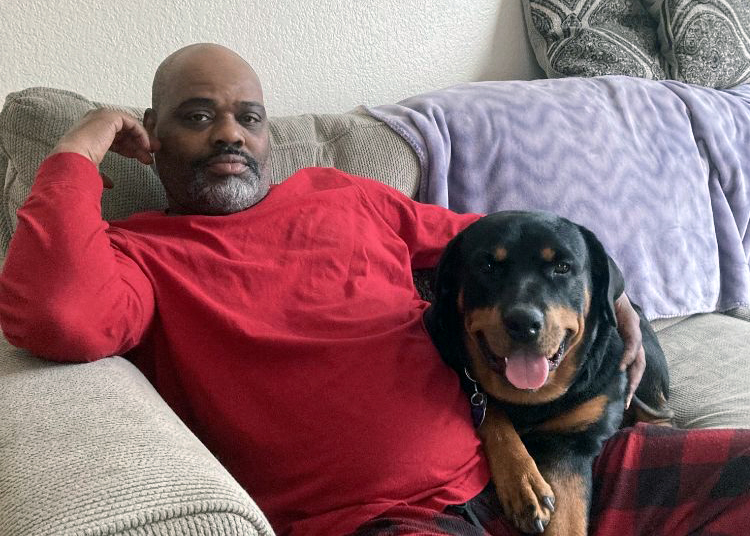
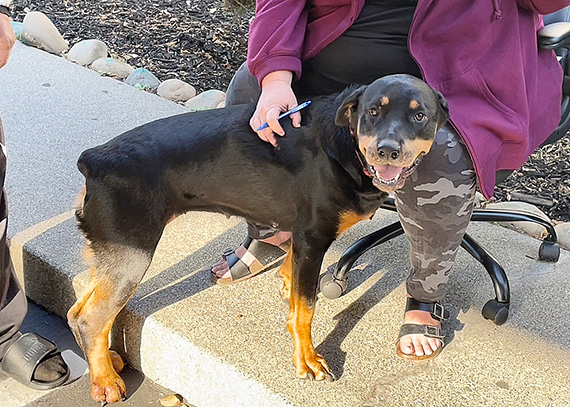
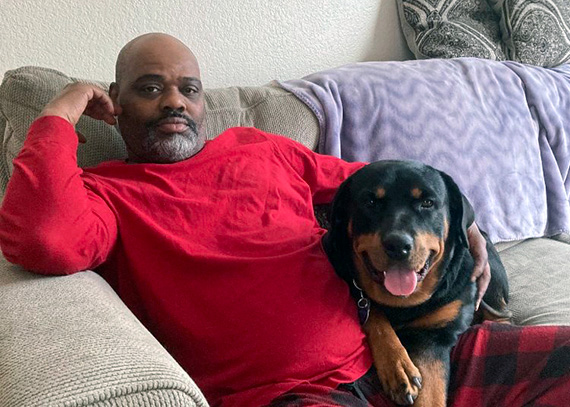
Determined to find help with vet care for her family’s dog Coco, Margaret searched for resources far and wide until she connected with Animal Services Officer April Stevenson. Thanks to Margaret’s perseverance, Coco is now back to cuddling with his favorite person, her husband, Marvin. (Credit: April Stevenson, left; Margaret Wagner, right.)
Coco proved to be a constant in a year of challenges: Margaret lost her job, and Marvin, who was diagnosed with congestive heart failure, began wearing a LifeVest to lower his risk of cardiac arrest. Coco, now registered as a service dog, never left his side. Then Margaret noticed sudden swelling in Coco’s back paws. A trip to the vet confirmed Coco would need further testing to pinpoint the cause, but the cost was out of reach.
Like many Californians struggling to find affordable veterinary care while availability shrinks, Margaret searched for support, determined to get Coco the treatment she needed, but came up against more barriers. “I had a notebook with four pages full of websites and agencies,” she says. “I applied at so many and got rejected from so many that it was heartbreaking, you know?”
In the living room with her husband, Coco resting on her favorite loveseat, Margaret realized to get Coco help, they would have to give her up.
It was the hardest decision I’ve ever had to make in my life.
—Margaret Wagner
Moving forward together
“I just looked at her, and I said, ‘I can’t do this anymore, babe. I can’t.’ I just started crying and I said, ‘I can’t watch her suffer.’ She had lost weight, and she had stopped eating, and she could barely walk. She wasn’t her happy-go-lucky Coco. I said, ‘We have to surrender her as much as we hate to.’ It was the hardest decision I’ve ever had to make in my life.”
She called 311 and was forwarded to Rancho Cordova Animal Services’ voicemail. It was 9 p.m. on a Saturday. Margaret didn’t expect to hear back, but then Animal Services Officer April Stevenson called. She listened to Coco’s story and said yes—not to transferring her to the shelter, but to teaming up with Margaret and Marvin to make sure Coco received the treatment she needed that weekend, thanks to Rancho Cordova’s Community Support Program. The program, established with funding from a California for All Animals grant, is one example of animal services agencies, shelters, and communities tackling systemic barriers that separate families and lead to pets who already have homes entering shelters.
“[This situation] started out sad, and it turned into this beautiful thing so quickly, all because of the grant,” says April.
After a trip to the emergency vet and medication to address the infection, Coco is back to her happy-go-lucky self, and she’s back at Marvin’s side. “She follows him everywhere. She lies either on the floor next to his side of the bed, or she’ll sleep at the bottom of his feet.” Margaret laughs. “Or if he is more towards the middle on my side, then she’ll lay right next to his side. That’s just how she is. That’s his baby.”
Stronger Side By Side: Meet CocoMargaret Wagner reflects on what it means to have Coco in her family.On how she’d describe Coco to someone who’d never met herA big, giant teddy bear. A heart of gold.On Coco’s favorite gamesI took her to get her one-year booster [at the animal shelter]. They have toys, leashes, harnesses, cat stuff. So they gave me some tennis balls, and there was also this wishbone. She hasn’t been able to chew through it yet, and she loves it. That’s her favorite toy in the world. My husband will take her to the park, and they’ll play tug of war, Frisbee, tennis balls.On Coco providing comfort during difficult timesMy husband ended up in the hospital shortly after we got her. When the paramedics came that day to get him, it was all I could do to keep her in the room. She was almost tearing my door down to get back out here with him. And when he came home from the hospital—she doesn’t leave his side—she was even more connected with him. I knew that she knew that there was something wrong with him.On Coco’s happy danceShe jumps up on her back legs and barks. Her tail is this tiny stub, so when she gets excited it’ll stick up a little bit, and her whole back end shakes.On rituals and greeting her dadAs soon as Coco hears that particular truck and trailer come in here, she knows. She’ll be asleep on the loveseat and then her head will pop up. She’ll listen, and then she’ll run to the door and start whining. Her little tail will just be shaking. And as soon as he comes in the house, man, she’s jumping on him. Daddy, daddy, daddy, daddy! He’ll sit down and take his shoes off, and she’ll sit on his feet and nudge at him, and she’ll give him kisses. And it’s funny because she doesn’t really lick you; she’ll put her cold nose on you.On a joyful momentIt was about three weeks after we got her and Marvin had to go to work. He had the LifeVest on at that point, and he sat down to put his shoes on, and she wouldn’t let him put his shoes on! She wouldn’t let him walk out the door. She grabbed [a shoe] by the shoestring and took it away. I had never laughed so hard in my life. My husband goes, ‘Coco, bring me my shoe.’ And she came out of the room without a shoe, like, I don’t know what you’re talking about, Dad, and then she jumped on his lap and wouldn’t move. I was like, Coco, Daddy’s gotta go to work! And she just looked at me like, I don’t know who you’re talking to.On finding out Coco wouldn’t have to enter the shelter to receive careI just bawled. And I looked at my husband and I said, Honey, God is good all the time, because he is really, really with us right now. I told him why, and he just started crying. We looked at Coco and it was like, I think she knew after he started crying. I think she knew that it was all gonna be okay, because she jumped up like there was nothing wrong with her, and she just got happy. She was giving him kisses, like, I’m gonna be okay, Dad. Don’t cry. It was like she knew at that moment that she was gonna be better.On the three best things about having Coco in the familyThe companionship, the love. And then my husband has to exercise for a certain amount of time during the day, and she gets him up to go for a walk. She motivates him.On why every community needs a program like thisThere’s been plenty nights where I’ve cried just thinking about it. I have a reminder every day because I look at her, and I see that she’s gotten better, and I’ve got my Coco back. There are going to be other animals, other families that are in a hardship like me and my husband, and there’s a chance that they’re not going to lose their loved one, like we didn’t lose Coco.
Previous
Next
For animal services officers, being in the field means collaborating to build safer, healthier, more compassionate communities for animals and people one conversation at a time. It’s countering conflict and cultivating connections among neighbors, bridging gaps in care to keep animals in their homes, and going the extra mile to reunite lost pets with their people. Join us in celebrating animal services officers across the state who are helping ensure people and pets, no matter what neighborhood they call home, have access to the resources they need to thrive together.
In 2014, Christina Avila was burned out. She took a hiatus from animal welfare and reluctantly returned a year later, when she joined the City of Perris Animal Control as Senior Animal Control Officer. “I didn’t want to do it anymore,” Christina recalls. “Then I was at home with three boys, and I had to come back to work. Financially… I was desperate for a job.”
Fast forward eight years: When Christina’s not online looking for lost pets or posting found pets to the local Facebook group, she’s checking in with neighbors and their pets, applying for grants and launching new programs, and passionately pursuing new opportunities that will help people and animals in Perris thrive. So how did Christina go from total burnout to lighting a fire under her team to adopt a new culture of support?
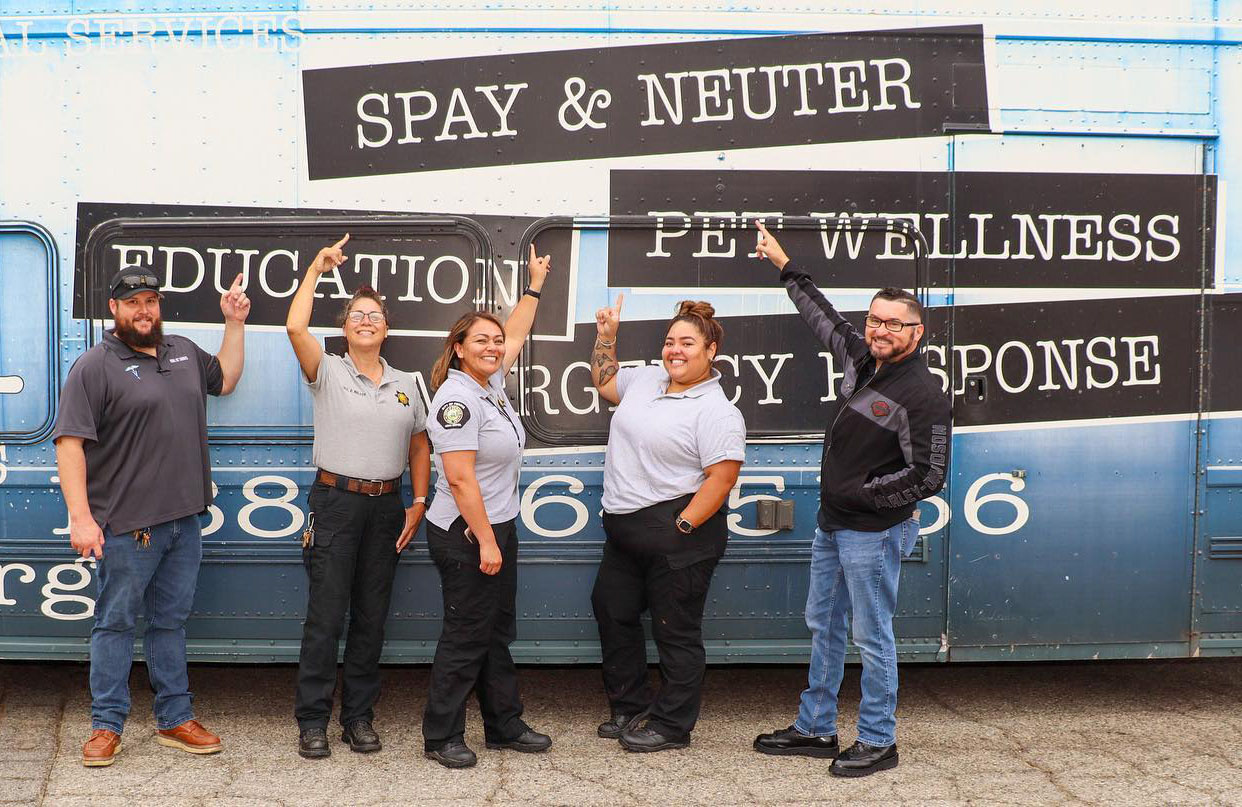
Driver Brad Rowe joins Christina, center, and her team pointing to the words “Spay & Neuter” on the Riverside County Dept. of Animal Services Mobile Spay/Neuter Clinic bus. Photo credit: City of Perris
From boxed in to blank slate
When Christina arrived at the City of Perris, an animal services agency that contracts its sheltering needs with Riverside County, there wasn’t much in the way of programs, a stark difference from the sizable organization where she’d been the previous eight years. There weren’t protocols in place to help lost animals return home or even a way to connect an animal with their owner. There were two options for a cat or dog brought into her agency: euthanasia or a ride to the county shelter.
If her previous organization had her feeling like she was working within a predefined box, Perris represented a blank slate. Christina immediately saw opportunity. “Here, if you are willing to go beyond your job description and want to do more, they’ll allow you to do it. I was given a chance to do what I wanted to do.”
Knowing the importance of building programs on data, she chose Chameleon to start tracking animals and outcomes and set up a licensing program to register owners to their pets. She opted to forgo redemption fees and kept the licensing fees nominal. With a foundation in place, she was ready to start building the department she envisioned, one that met families where they were and offered support to keep pets in their homes.
How her past shaped her forward-thinking vision
The hardest part is getting people to understand we can help, that we’re here to help. I’m here for you, and I’m going to go all the way.
—Christina Avila
Christina never had money growing up, but her mother always scraped together the funds to get their animals spayed and neutered. “My mom related to animals. I’ve always had that empathy for dogs and cats. Growing up an only child, those were my brothers and sisters. But I also relate, too, to growing up in the Hispanic culture where, like, dogs don’t come in the house.”
Avila credits her upbringing for adding balance to her approach and giving her a well-rounded view of the world. Having watched people in her own life lose their housing while struggling with addiction, she recognizes the need to dig beyond the surface to find the roots of challenges and address the systemic issues that fuel cycles.
“Everything is not so black and white. What do they need? Is there an opportunity to educate? Every situation is its own situation. What’s working for this family doesn’t work for this family or this family.”
From firsthand experience, she also knows it’s not enough to announce a change in approach from punitive to supportive; agencies need to build trust with the community. “If the dog is being cared for, I’m not here to take it from you. The hardest part is getting people to understand we can help, that we’re here to help. I’m here for you, and I’m going to go all the way.”
His name is Julio: Keeping pets and people together
Christina recently had an opportunity to build that trust while working with a woman whose dog had developed a hematoma. She wanted to have it removed, Christina learned, and was committed to doing the daily post-op vet care, but she couldn’t afford the surgery.
“Back in the day we would have said, okay, you can sign it over. And we would have euthanized the dog. And now, now… his name is Julio. Julio has a life! And they want to keep him, and this is a family member. I was able to call the county, and with some of their grant money, they were able to fix his ear.”
Christina has worked hard to redesign her department’s culture and counter the assumption that the only two choices are a trip to the shelter or euthanasia, but she recognizes the difficulty that arises when the vet care pet owners want is out of reach. And in Perris, as in much of California, essential vet care such as spay and neuter can be especially hard to come by.
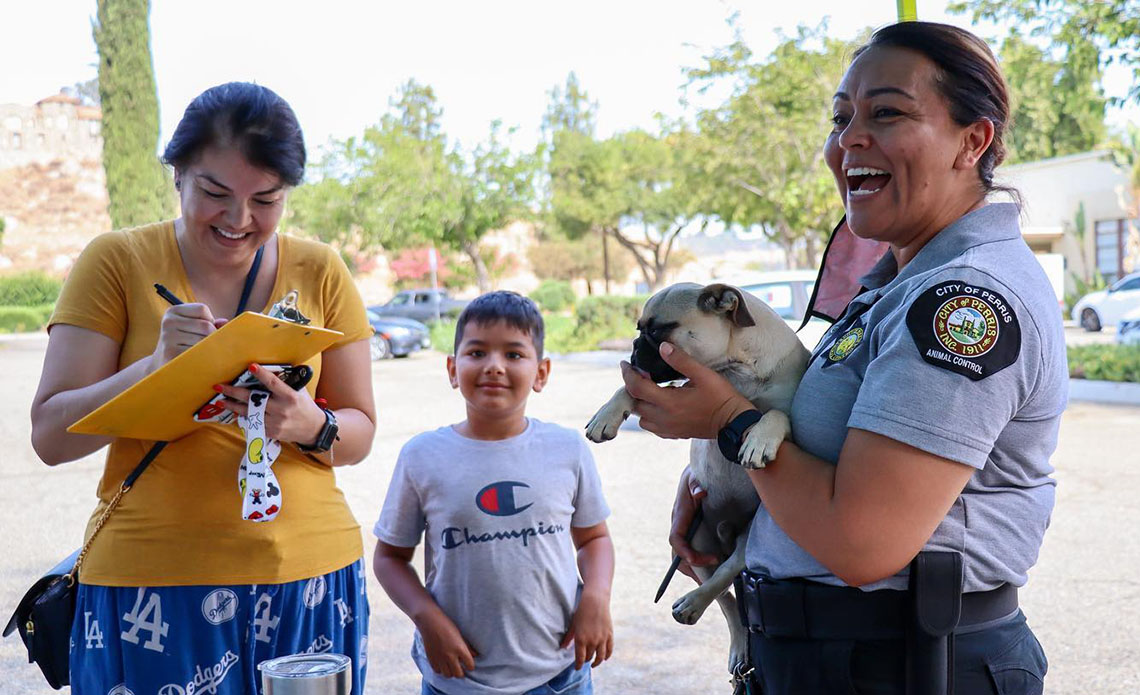
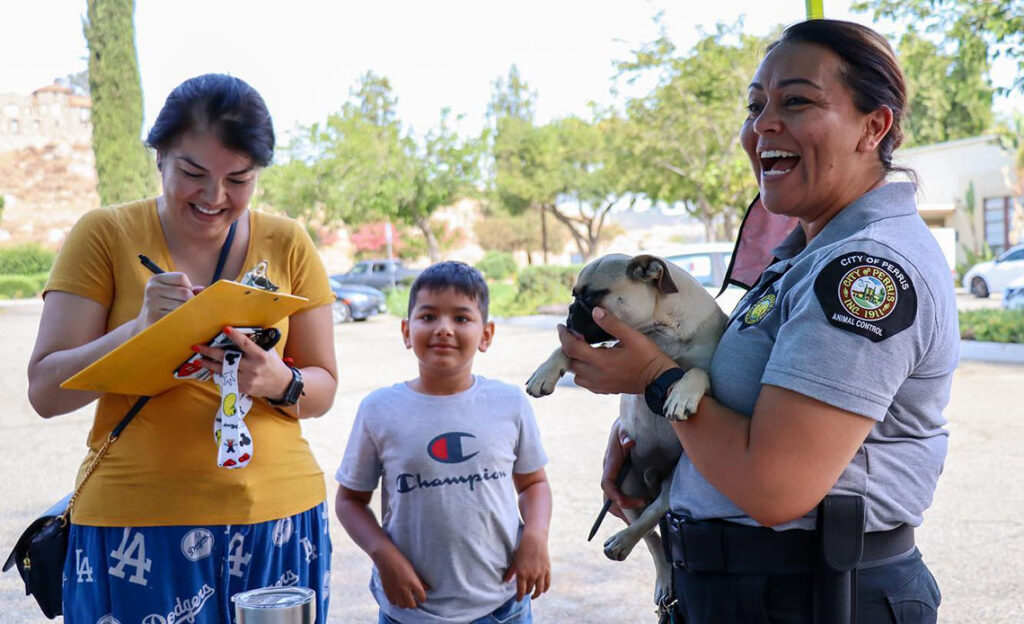
Christina holds a small dog during a spay/neuter event while a woman signs a clipboard and a young boy looks on. Photo credit: City of Perris
Perris has a population of nearly 80,000 residents, many of whom have pets they love, yet only two options for sterilization: one is highly restricted, and the other, costing $300 or more, is unattainable for many working families. Christina knew a mobile clinic would make a huge difference for families in her community, if she could raise the funds to host it. When she saw the California for All Animals grant opportunity, she jumped.
“I didn’t ask anybody. I’ve taken one grant writing class and I was just trying to use my smarts. I was just hoping, hoping to get money to help the community. And it came through! I was so surprised! I think that was one of the happiest days of my life.”
Christina also secured a grant from the Pet Lover’s License Program to have another 75 large dogs sterilized, a grant to offer microchips and identification to every animal officers pick up. Her department is also currently participating in the Open Arms Challenge with the theme of “Mending Fences,” an initiative that would provide fence repairs, dog houses to shield animals from the hot summer sun, and humane deterrents for residents concerned about community cats in their yard.
Although it’s still early, she’s already seeing the fruits of her efforts. After receiving a California for All Animals grant to microchip animals, her team started using 24PetConnect and posting photos of lost dogs to various lost and found boards. Compared to the same three-month period in 2022, her team has more than doubled the number of dogs they’ve returned home. “And now we’re trying to think about what else we can do, “says Christina. “What else can we do to keep these animals from going to the shelter?”
As for Julio, “He’s doing good. I was just over there visiting him yesterday. He had his cone on and his owner was just so appreciative.”
The career-altering gift of autonomy
Ultimately, every one of these bright spots fueled Christina’s journey from burned out to on fire, with one in particular sparking her shift: an organization that believed she could do it.
“I felt valued here. […] Here, my ideas—I could go through with them. I could try something new. I wasn’t in a box anymore. I think that’s where my positivity comes from. I’m grateful I finally get to do what I always wanted to do.”
Perris also granted her the space and safety to reflect on her past. “I don’t think I was ready to be a senior officer. I was struggling with self-reflection in my personal life too, but as time has gone on, I see what my actions can do to other people. I’ve grown a lot in these past seven years. A lot.”
Today, she knows the power of autonomy and makes a point to ask her team for their input and opinions.
“How you show up, it really matters,” she says. “I want to carry with me everything I have to share. I think we all have something to share and we shouldn’t be afraid to share it, and I try to bring that out in the field. Like, I’m here for you.”
She wants other officers who might not feel like they are in the driver’s seat to know that their actions do have an impact: “Own yourself and don’t let the job own you,” she says. “You picked up a dog that you know was spayed, go pound that cement. Go door to door. Return that dog. Maybe you don’t do a couple of calls, but you get that dog home. And that dog doesn’t enter the shelter. You can make a difference.”
“This is really, really hard, and we wake up every day, and we come to our jobs to help.” In this short clip, Christina reflects on what she wishes everyone knew about the true nature of the work, opens up about one of the most difficult moments of her career, and shares how she got through it.
California for All Animals Year in Review with Nadia Oseguera
On February 14, 2022, California for All Animals launched with Welcome Grants for animal shelters and an invitation for shelters, partner organizations, and allies to join forces to achieve our shared goal of matching every animal in need with the right outcome through the right care, delivered in the right place and at the right time. We invited Program Manager Nadia Oseguera to reflect on the first year of Cal for All Animals and share more about what’s coming in 2023.
Cal for All Animals awarded over $15 million to shelters and animal control agencies in 2022. What difference do you think this will make for California shelters and communities, and for people and pets?
I fully recognize that sustainable change takes time, but $15 million means that shelters can turn their ideas into action. I joined the team in the middle of the Sniptember spay/neuter-focused grant cycle. I immediately dove into researching low-cost and free spay/neuter services across California and meeting with organizations to hear about their proposals. We awarded nearly $10 million in funding for spay/neuter projects. For some the funding meant they could catch up on a backlog of intact animals; for others it meant getting the veterinary staff support they needed, and for other organizations it meant extending much needed low-cost or free services to their community. I’m now in the process of checking in with organizations who were awarded funding in the spring 2022 Open Grants cycle. Those grants enabled organizations to start innovative programs, and shelters placed a big focus on community partnerships — from programming centered on foster care, community cats or community engagement.
What can we look forward to in the year ahead?
This year we’re recognizing how crucial it is to focus on breaking barriers and building bonds between pets and people and within our communities, inside the shelter and out. No matter our circumstances or individual differences, we all want to see animals thrive in their homes and with their people. We know that organizations can bring more pets and people together by building trust in the community and by ensuring all Californians — regardless of age or race — can share our love with a pet. We’re supporting shelters with the funding and tools needed to remove barriers to live outcomes one incremental, powerful change at a time.
Why is the focus on removing barriers so important?
Barrier-busting is all about removing the roadblocks that get in the way of keeping people and pets together. Barrier-free processes enable organizations to preserve or facilitate relationships between pets and people via foster care, adoption or return to home. I always go back to the approach that has guided my work: If people want to help, whether through adoption, fostering, or volunteering, I want to make that possible for them. Barrier-free processes also require trust in the community and prioritize racial equity, because Black, Indigenous and people of color who love their pets are most often harmed by barriers.
We put barriers in place with good intentions, but they contradict our desire to ensure that every animal in the shelter returns to their home or finds a new home as quickly as possible. For example, most organizations with adoption or foster applications aimed at ruling out less-than-“perfect” adopters or fosters are really trying to protect the animals in their care. But none of us are perfect, and all of us have love to give! This emphasis on looking for reasons to say no leads to animals spending a longer amount of time in the shelter, families not being reunited with their pets, hopeful adopters feeling unworthy of the companionship of a pet, and shelters needing to make difficult outcome decisions. Barriers not only harm the community but also animals and the dedicated people in shelters who care for them.
You’ve connected with shelters across the state over the last six months; what stands out?
Connecting with shelter leaders and their teams on an almost daily basis has reaffirmed my belief that the animal well-being space is just as much about the people as it is about the animals. A recurring theme is a desire to keep people and pets together. What that looks like might be different for each shelter — depending on their unique circumstances. However, I always leave every conversation feeling appreciation and gratitude for the front-line efforts to disrupt the status quo and do things differently for the sake of the animals and people in their communities.
No matter our circumstances or individual differences, we all want to see animals thrive in their homes and with their people.
Animal shelters, partner organizations, and the people and pets they work with are facing challenges, including the impacts of a state and nationwide veterinary shortage (see “Study Confirms Veterinary Shortage” in this newsletter). What gives you hope on difficult days?
I think it’s important to celebrate the wins — no matter how big or small. We know that access to care and veterinary staff shortages are a big challenge that we can’t solve overnight. While barrier-busting is a priority this year, we’re not losing sight of the access to care crisis or how the two intersect. In fact, I’m hopeful that shelters in communities most impacted by the access to care crisis can continue to find creative and collaborative ways to move forward by meeting people where they are, acknowledging their full humanity and recognizing the role they can play in improving animal well-being.
That means leaning further into the understanding that potential adopters may have trauma resulting from systemic harms experienced in their communities, but that trauma doesn’t define them. It means not denying a loving home to a cat or dog simply because we’re afraid that home might not meet a narrow, often unexamined ideal of perfection. It means removing more roadblocks that break the animal-human bond and building more partnerships with community members and organizations. This is already happening, and we celebrate and commend shelters for every baby step and every win along the way!
More than 8 Million Dollars for California Spay and Neuter During Sniptember!
Making up the spay/neuter ground lost to COVID is a daunting but necessary task…and necessity is the mother of invention. More than 40 shelters are in the process of receiving a combined $8M+ in Sniptember grants to pursue their innovative approaches to increasing spay/neuter capacity.
That innovation includes new partnerships within communities and collaborations reaching across the state.
For example, Marin Humane is teaming up with CAMP (Community Animal Medicine Project,formerly SNPLA) on a multi-year program to train veterinarians in High Quality High Volume Spay/Neuter (HQHVSN) surgical and clinical techniques.
In Los Angeles, Paws for Life K9 Rescue is joining with Companion Pet Partners, Los Angeles Animal Services (LAAS), California Department of Corrections and Rehabilitation (CDCR), and Annenberg PetSpace to launch a first-of-its-kind Vet Tech training program in the correctional setting. Grants are also supporting partnerships between the SF SPCA and the Central Valley, and Fresno Humane and Animal Balance. Hollister, Wasco, Monterey, Salinas and others will be increasing their S/N capacity via the SNIP Bus (Spay Neuter Imperative Project), a 501(c)(3) low-cost mobile spay and neuter clinic.
In all, we received 103 Sniptember proposals totaling $46,645,663.98, a number that nearly exceeds the entire budget for the five-year California for All Animals program. This astounding response not only reinforces the need for continued investment in building our spay/neuter capacity in the face of nationwide veterinarian shortages; it’s also a testament to shelters’ and partner organizations’ creativity and commitment when it comes to expanding opportunities for pets and people in their communities.
Record Number of California Organizations Are Up for the Open Arms Challenge
As part of our yearlong focus on barrier busting and bond building, California for All Animals joined with 21 national organizations to invite shelters, foster-based organizations, and public charities focused on keeping pets and people together to join the 2023 Open Arms Challenge.
California really stepped up, with 106 orgs submitting applications. They’ll spend March prepping (for example, by updating procedures and policies and/or training staff and volunteers) and April implementing their newly more welcoming practices.
Study Confirms Veterinary Shortage
More than 344,000 California shelter animals do not have adequate access to veterinary care staff, according to a recent survey that highlights how veterinarian shortages are profoundly impacting California’s most vulnerable animals. Shelters are becoming overcrowded, illness is rising, and adoptable animals are being euthanized.
The shortage of veterinarians and RVTs means 25% of shelters are unable to provide essential veterinary care and 68% of shelters cannot consistently provide complete care to treat conditions commonly seen in shelters, such as fractures, eye injuries, and dental problems.
The survey results reveal the scope and urgency of the crisis and underscore the need for all Californians to come together to address it. Contact your local and state representatives to advocate for long term solutions in addition to direct funding. This could include expanding the training pipeline for veterinary professionals at all levels, increasing the availability of retraining (e.g., specific to spay/neuter) for veterinarians who have been out of the workforce, streamlining licensing practices to allow greater mobility into the state, expanding the role of registered veterinary technicians, and considering the potential of an appropriately trained and licensed mid-level practitioner similar to a Physician’s Assistant in human medicine.
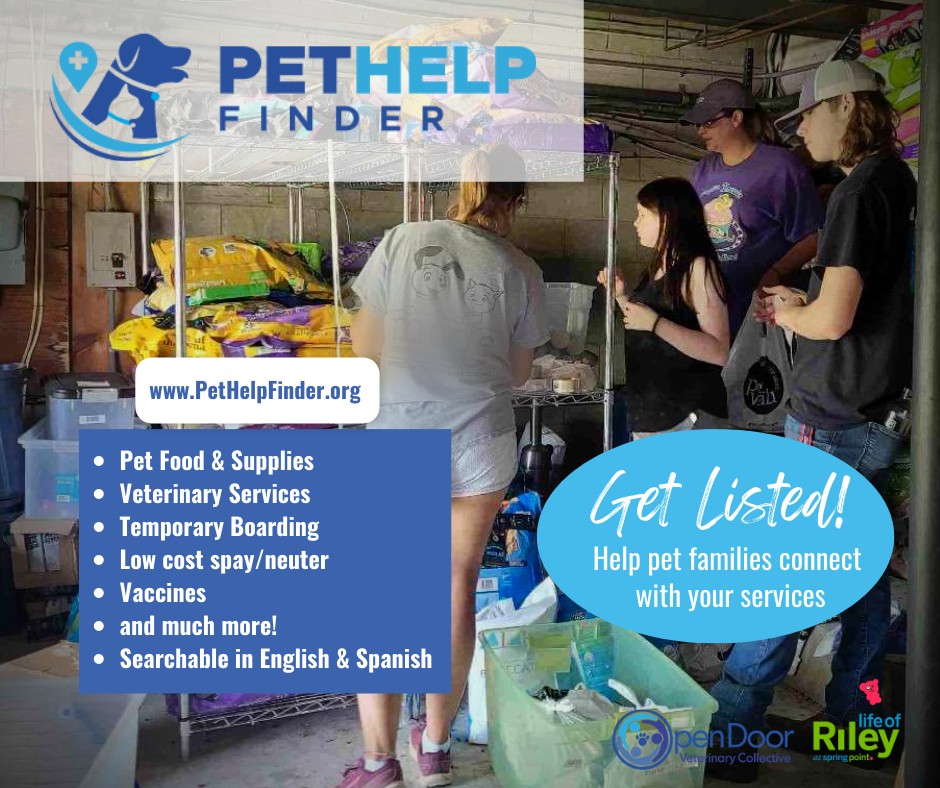
PetHelpFinder.org
PetHelpFinder.org is finally here! If you are an organization that offers financially friendly pet services, this was built for YOU!
Over 1,500 providers are already connected to this easy to use, searchable site. List your services and events and connect with pet families looking for you all in one convenient location. You can even use your calendar to announce vaccine clinics or offsite pet food distribution days.
You’re invited to the new All Call experience—same day, same time, different style. Inspired by your feedback, our Zoom community calls have transformed into two tracks.
Join us twice a month at 2 p.m. on the first and third Tuesdays, or pick the track that fits you and your schedule best.
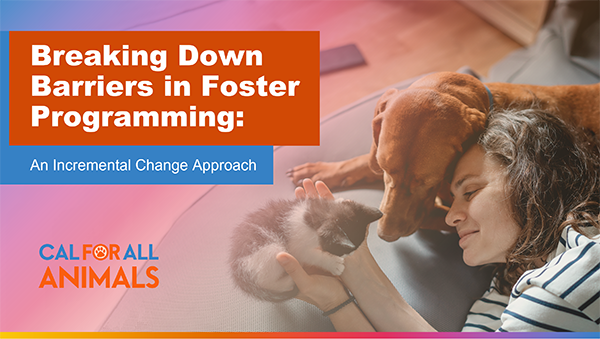
View the recording of last week’s presentation on breaking down barriers in foster programming.
First Tuesday calls will be operations-focused and topic-driven, featuring a short presentation with time for discussion and Q&A.
Third Tuesday calls will continue to lean in to your coaching questions, with space to chat in breakout rooms and as a larger group.
On February 21, we’ll be discussing questions related to removing barriers to fostering; sign up to preview call topics and receive related resources and recaps.
The heart of the calls remains the same: you. Register and grab some time to connect, collaborate and celebrate progress with your California colleagues.
Paws to Appreciate
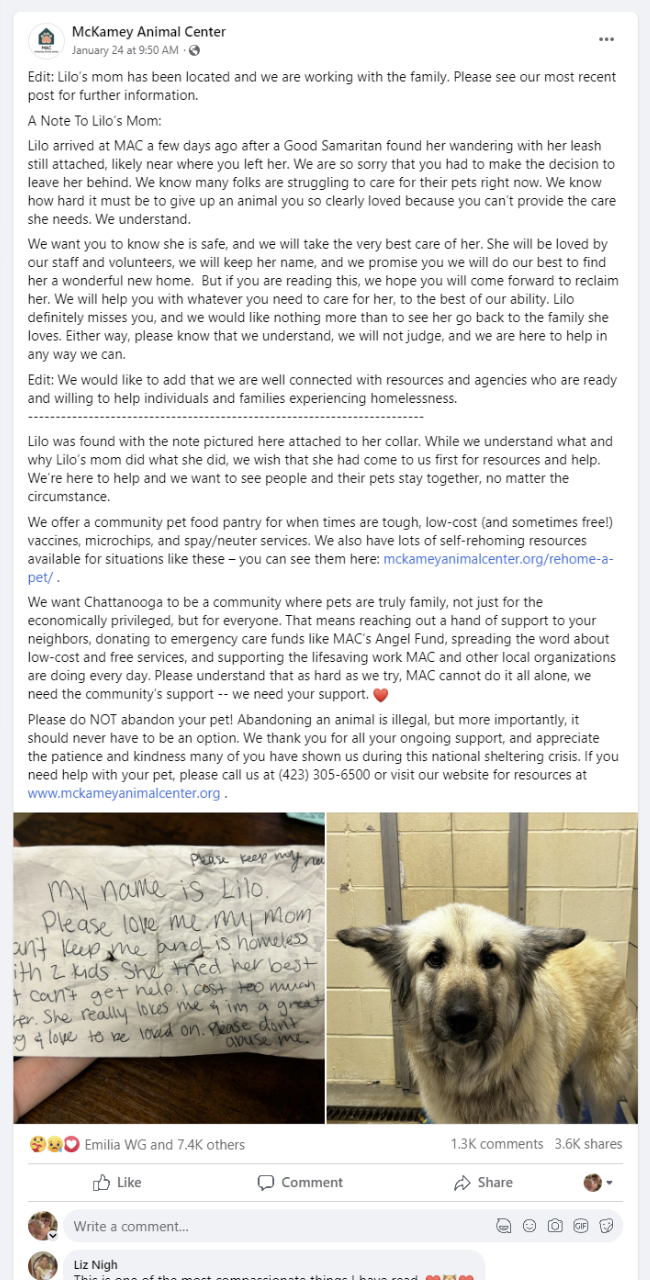
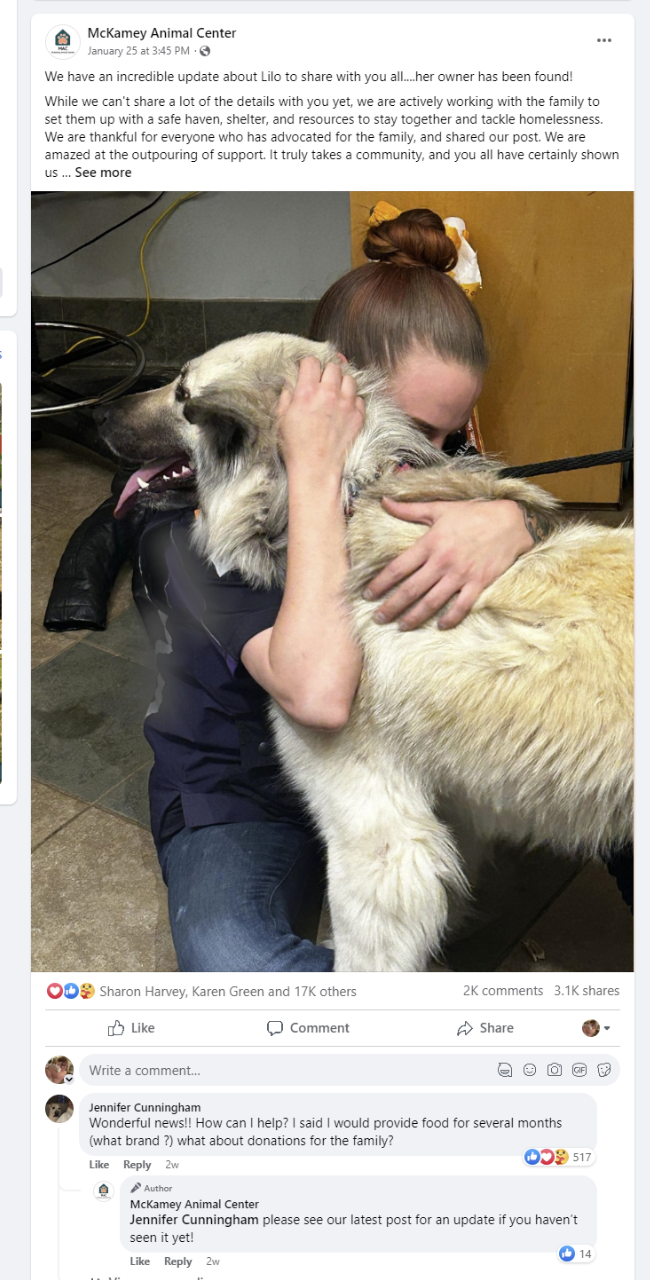
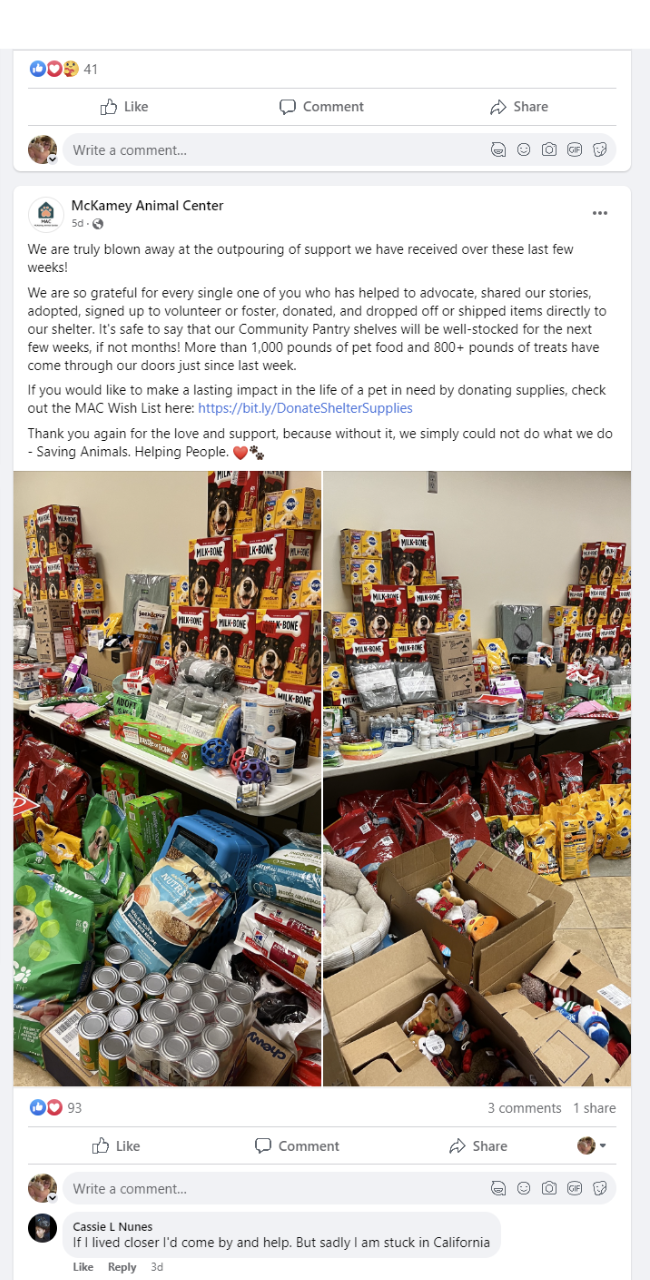
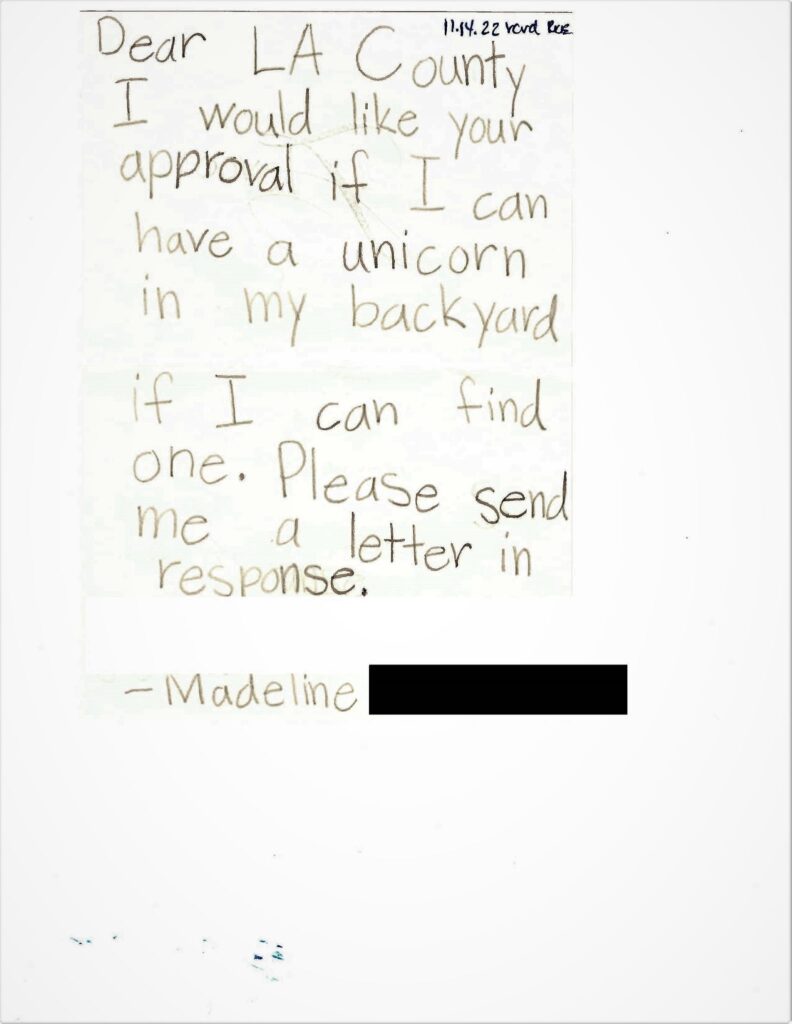
If you’ve opened the pages of the New York Times or turned on CBS Mornings, or spent less than a minute in your social feeds lately, you’ve likely seen the story of Madeline and her unicorn or Lilo’s reunification with her family. One thing is clear: we’re hungry for a different type of storytelling, one that centers people with their pets and lifts up the human-animal bond. If the story of Lilo and her family told by the McKamey Animal Center of Tennessee is any indication, compassion-forward care is a value that is universally shared and monumentally supported. Check out the food pantry bounty delivered by supporters far and wide in response to this heartwarming story.
Updated ASV Guidelines Provide a Roadmap to the Right Care
Next up for your shelter team book club: More than a decade after the publication of the Association of Shelter Veterinarian’s Guidelines for Standards of Care in Animal Shelters, this foundational document has received a big update.
“We worked hard to consider implications on community well-being, other stakeholders and staff,” Chumkee Aziz, DVM, said. “Our hope is that the Guidelines provide shelters with updated standards in animal sheltering, while encouraging shelters to also focus on equitably supporting their community and keeping pets in homes.”
The second edition expands the basis for capacity for care and core ethical framework for animal well-being from the Five Freedoms to the Five Domains. The Five Domains go a step beyond the Five Freedoms to emphasize that animals deserve not only freedom from negative experiences while in the shelter, but also positive experiences that contribute to overall mental and physical well-being.
Davis, Calif., Dec. 12, 2022 – California for All Animals has completed awards totaling more than 5.8 million dollars to animal shelters across the state through its spring 2022 “Open Grant” cycle. Launched in February 2022, this five-year, state-funded initiative—administered by the Koret Shelter Medicine Program (KSMP) at the UC Davis Center for Companion Animal Health—reflects California’s commitment to ending euthanasia of healthy and treatable animals in shelters and creating communities where all pets and their people, no matter where they call home,have access to the resources, relationships, and opportunities they need to thrive.
The spring grant cycle focused on keeping animals in their homes through growing shelter and community-centered programming so that every at-risk animal can receive the Right Care in the Right Place, at the Right Time, and to the Right Outcome.
“We all know pets and people belong together, and the reality is most animals entering shelters are loved and wanted. Everything from an unexpected illness to rising grocery bills can force families to surrender their pet; something as simple as a fence that needs repair can lead to a lost dog,” said Allison Cardona, California for All Animals director. “Together, we’re responding to these challenges, and we’re proud to fund shelters’ efforts to develop and integrate essential resources that keep animals with the people who love them, or help them succeed in new homes when needed.”
Over 60 shelters received grants in support of proposals that lay the tracks for a system of care that builds and sustains animal health and well-being in the community, inside the shelter and out. These initiatives connect people and animals with the resources they need to move forward in life together, whether that’s through addressing issues that prevent families from getting veterinary care or securing pet-inclusive housing, or joining forces to make sure lost pets return home.
“With this grant, we’re creating a network of neighbors ready to help locate a lost pet’s family, starting by making microchip scanners available at easily accessible locations, including police departments and fire stations, said Tracy Mohr, Chico Animal Shelter Director.
“Next, we’ll expand this network to include neighborhood volunteers known as ‘Pet Pals.’ It’s a team effort—we all want to do the right thing to help pets get reunited with their owners. What better way to empower our community but to provide people with the tools to help them be successful.”
Other shelters participating in California for All Animals are establishing a strong foundation for well-being by expanding spay and neuter capacity; increasing positive outcomes through adoptions, foster programs, or animals reunited with their families and returned home; strengthening the physical, medical, and mental well-being of animals in the shelter; and boosting community services and partnerships through expanded opportunities for engagement, veterinary care, and pet supplies.
In what ways could you increase live outcomes, promote animal well-being in the shelter, or provide more or improved surrender-prevention services outside the shelter walls if you had the funding? That’s what we asked shelters when we launched our Open Grants cycle last May.
Please join us in congratulating your fellow California shelters and grant recipients as they embark on community-centered initiatives that work toward a more inclusive ecosystem in which Californians and their pets have equal access to the care and support they need to stay together.
Thank you for helping keep people and pets together!
More than $5.8 million dollars has been awarded to 64 shelters via this grant, providing funds for vaccines, mobile spay/neuter and other veterinary services, behavior and training support, voucher programs to increase access to care, and more.
“Californians know pets and people belong together, but everyday economic and social stressors—from an unexpected illness to rising grocery bills—can too often tear families apart,” said Allison Cardona, California for All Animals director. “We’re proud to fund shelters’ efforts to develop and coordinate the essential supports and resources that keep animals in their homes with the people who love them, or help them succeed in new homes when needed.”
Up Next: the response to the Open Grants call and speaking to shelters made us aware that California was no exception to the national shortage and gap in spay/neuter services, so our next grant opportunity aimed to help shelters expand s/n capacity. In total, 103 proposals totalling $46.6 million in requested funding were reviewed at the close of the Sept/Oct Sniptember grant cycle—that’s a lot of snippin’! Awarded applications are in the process of being finalized and details will be shared soon.
Neighbors Helping Neighbors
It’s Christmas morning over here! Now that Open Call is mostly wrapped, the wait is over: Let the unpacking begin! Over the next few months, we’ll be sharing the treasure trunk of innovative programs designed by you and your peers and highlighting bright spots coming from every corner of our state.
First up on our California shelter tour is our northern neighbor Chico Animal Shelter, led by everyone’s favorite renegade, Tracy Mohr. Mohr has never been one to let perceived barriers deter her, and her penchant for, “Sure we can! Why not try?” problem-solving is often credited for Chico Animal Shelter’s history of forward-thinking programming.
Pet Pals, a program launching early 2023, will allow lost pets to stay in their neighborhood until their parents can pick them up by asking neighbors if they are willing to help out. “Studies show that pets removed from their neighborhood and taken to a shelter are less likely to be reunited with their owner by a factor greater than 10. That’s huge! We can’t ignore that,” said Mohr. “We need to share that information with our community and work together to keep pets close to home.”
The question on Mohr’s mind: What to do when a finder isn’t in a position to help?
“We’re going to use NextDoor to locate an ambassador in each neighborhood,” Mohr explained. “Ambassadors—Pet Pals—will allow lost animals to hang out at their Pal’s house until their families can be located. They’ll post photos and descriptions to our designated sites, and they’ll be equipped with a scanner so they can phone the microchip company and alert the pet’s parents.”
Mohr is More: We’re dreaming of Pet Pal flair!
Mohr is planning a soft launch that will utilize police and fire stations as the first Pet Pal locations before expanding to include trained volunteers. “Shelters are here for pets that are in crisis and do not have another option. We’re always here to help should that moment come, but we can do a lot before that moment. In fact, if we work together, we may even prevent it.”
Bootcamp Grad-itude
For fourteen California shelters, this fall marks the culmination of Four Rights Bootcamp and Daily Population Management Rounds Bootcamp.
Led by Dr. Cindi Delany, Daily Population Management Rounds Bootcamp is the latest transformative Bootcamp offered through the Maddie’s® Million Pet Learniverse. It helps shelters master the why, how, when, where, and what of implementing and performing rockstar daily rounds to improve animal health and welfare, increase the number of animals and people they can help, while decreasing staff workload and burnout, length of stay, and the number of animals waiting in the shelter.
The heart of Four Rights Bootcamp is to support participants in asking, “What would it take to move out of crisis mode and move towards operating in a more sustainable and equitable system?” Together, shelter leaders reflect on this question through the lens of the Four Rights—Right Time, Right Place, Right Care, and Right Outcome—in order to consider how things could look and feel different for their shelters, themselves, and for the animals and people in their care and in their community.
“There is so much value in working with shelters in this setting, particularly when folks share their own shelter’s experience with the group, or share skills and knowledge with one another,” Ivy says. “This presents not only a learning and growing opportunity for Bootcampers, but also for us as KSMP facilitators.”
It’s an ongoing conversation, Becky says. “Everyone is able to share their day-to-day experiences, challenges, and wins. We aim to meet folks where they are, rather than imposing our ideas about what is important or a priority. ”
Ultimately, Bootcamps are about sparking questions, trying out new ideas, and building a solid foundation for change through relationships. “Because of the immense challenges our industry is facing right now, we recognize that there are no easy answers,” Chumkee says. “Our hope is that Bootcamps provide a community of support where participants feel enriched by one another, and where our team can encourage participants to rethink how things are done in their shelters so that, even in the midst of serious struggles, some light can shine through.”
Bakersfield SPCA – Bakersfield, CA Calaveras County Animal Services – San Andreas, CA City of Bakersfield Animal Care Center – Bakersfield, CA Fresno Humane Animal Services – Fresno, CA Hayward Animal Shelter – Hayward, CA Kern County Animal Services – Bakersfield, CA Madera County Animal Shelter – Madera, CA Pasadena Humane – Pasadena, CA Riverside County Department of Animal Services – Jurupa Valley, CA San Diego Humane – San Diego, CA San Francisco Animal Care & Control – San Francisco, CA San Jose Animal Care and Services – San Jose, CA Stockton Animal Services – Stockton, CA Tri-City Animal Shelter – Fremont, CA
Join over 1900 of your peers in the ever-expanding Maddie’s® Million Pet Challenge Learniverse! The newest SPOT mods (Self-Paced Online Training modules) include The Right Care and The Right Outcome, two courses that complete a series exploring each of the Four Rights, an evolution of the Million Cat Challenge’s Five Key Initiatives and the foundation of Maddie’s® Million Pet Challenge, where every element works in concert to support one another.
You can continue to bust barriers and boost positive outcomes with The Power of Yes!, inspired by California State Director Allison Cardona’s powerful webinar—you’ll learn three of the most impactful and untapped practices you can use to encourage engagement across your community, open kennel doors, and send more animals home.
The All Call is a space set aside specifically for California shelters to network, collaborate, learn, grow and share. It’s a space created by all who participate and shaped by the feedback you provide. Please take a moment and tell us what you’d like to see added in 2023!
Did You Know: Save Money with Buyers Cooperatives
One shelter probably can’t buy enough supplies to qualify for a bulk discount–but ten can! That’s the idea behind groups like the San Francisco SPCA’s Compassion Collective Purchasing Program and Shelters United.
Shelters and rescues can sign up for the SF SPCA collective at https://www.sfspca.org/compassion-collective/ for free. Once you join the collective, you’ll qualify for bulk discounts on veterinary supplies, medical supplies, and equipment.
Non-profit animal welfare organizations can also sign up to Shelters United for free. Browse to https://sheltersunited.com/ to find out more.
Calling All Helpers!
Last month, Maddie’s Fund®, together with The Ad Council and The Humane Society of the United States launched a new PSA campaign, “Pets and People Together,” to inspire pet lovers everywhere to #BeAHelper.
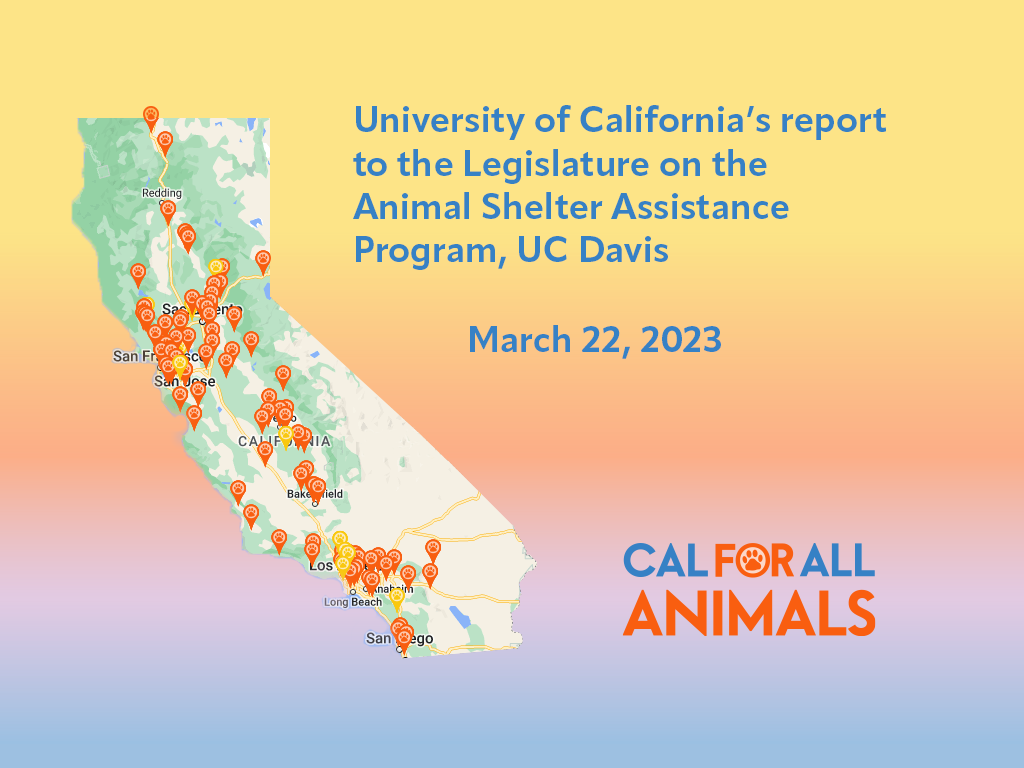
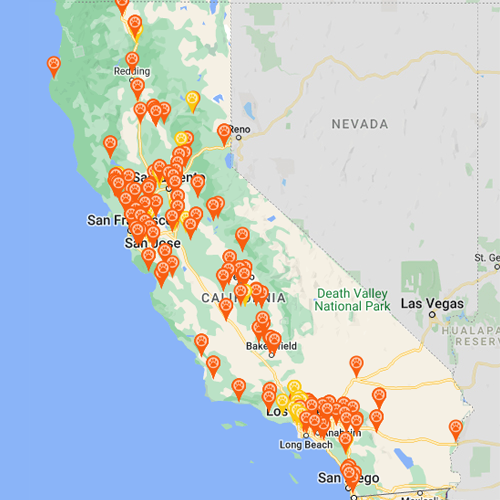
From Siskiyou to Chula Vista…View the shelters and supporting organizations that have joined so far on our interactive map.
Notice anyone missing? Tell them about California for All Animals!
Paws to Appreciate
Los Angeles Department of Animal Care and Control’s response to this hopeful letter from little Madeline.
Click on letter to read the rules and regulations of unicorn guardianship.
Portaling California
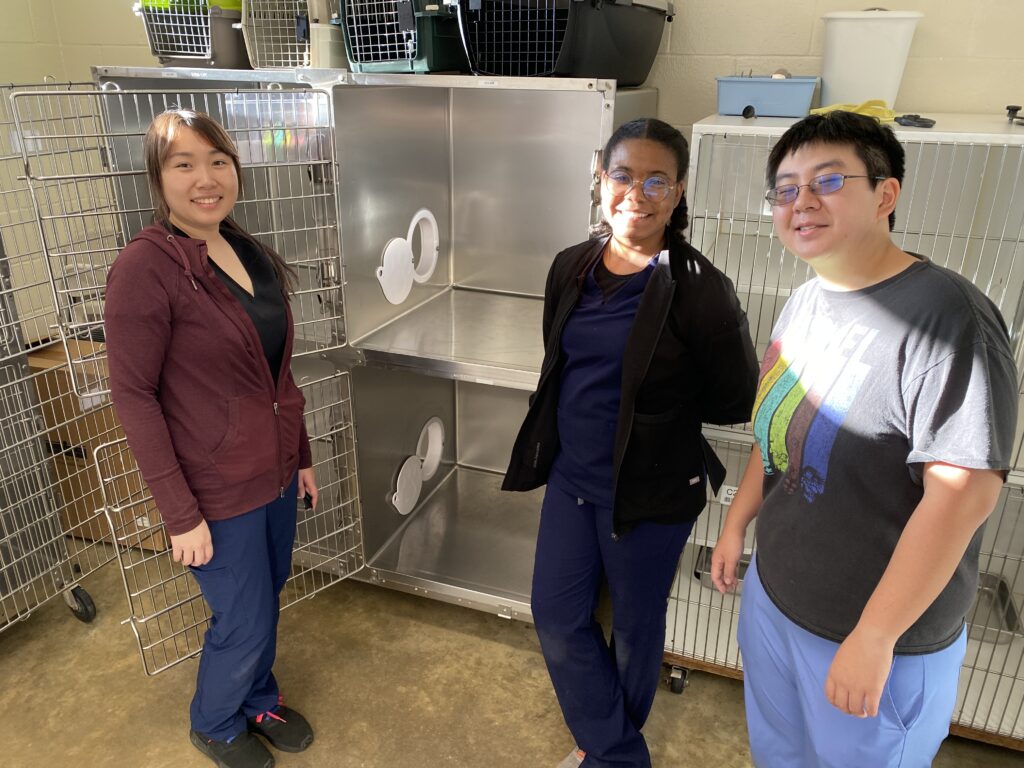
Veterinary students + Portals + Amador County Animal Control and Adoption Center = A few of our favorite things! Led by Dr. Denae Wagner, UC Davis veterinary students learn the importance of animal-centric housing and gain hands-on experience creating double compartment suites at neighboring shelters. Pictured below: Chia-Lin Lee (3rd year), Cassia Hazel (1st year) and Stephanie Hidai (2nd year) installed 15 portals, which calculates to about 9,460,800,000 minutes of outstretched joy!!!
UC Davis veterinary students install portals at Amador County Animal Control and Adoption
Does your shelter need portals? You may qualify for a portal grant. Fill out the form at tfaforms.com/5027055 to request a portal consultation with our facility design team.
“In all my years in animal welfare this is perhaps the most meaningful and actionable training I have received. This conference came at just the right time for our teams as we are tired and needed a light at the end of tunnel and validation and hope for the direction we are going.”