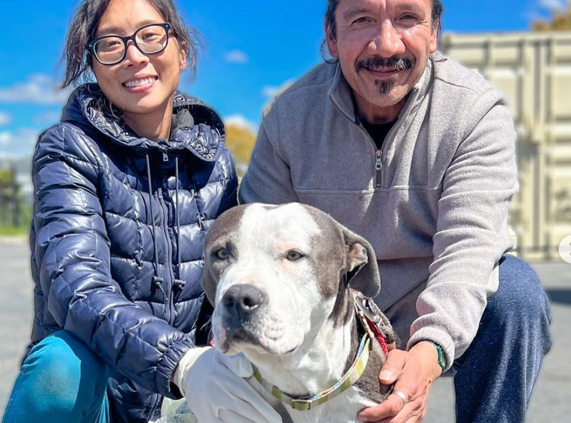
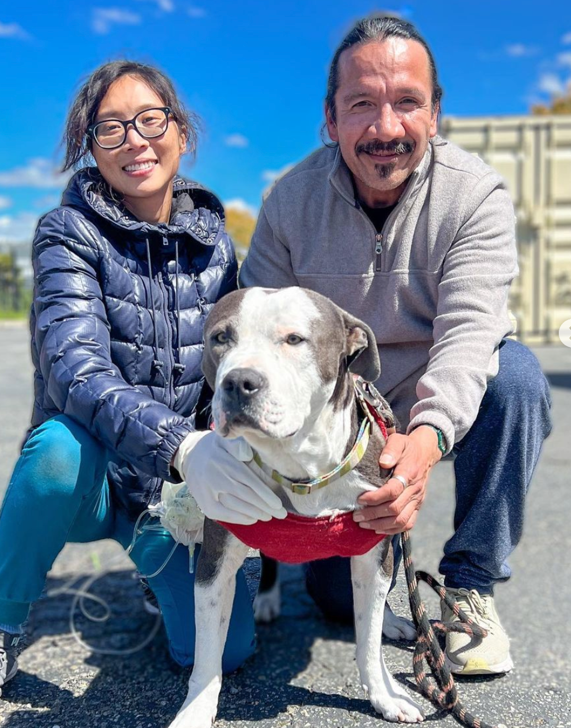
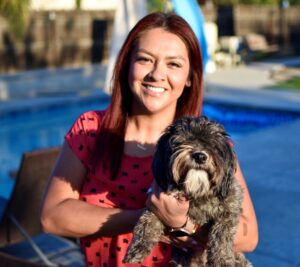
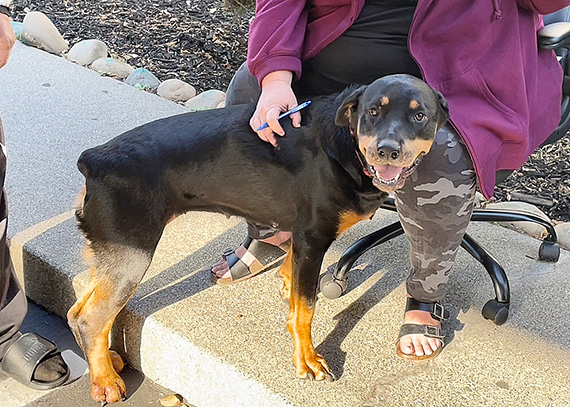
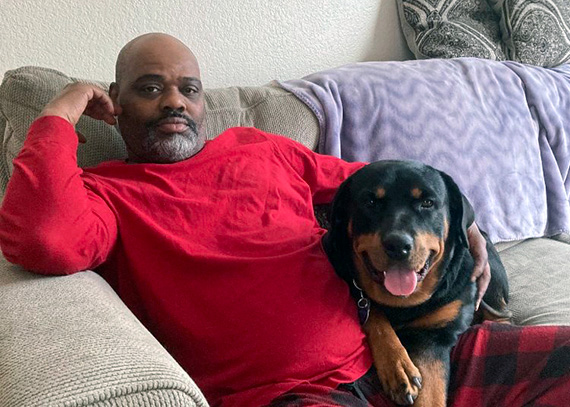
Families find the care they need for their pets in partnership with Vets in Vans and Oakland Animal Services.
They’re far from alone. Rising costs and a nationwide veterinary shortage mean guardians and shelters alike are increasingly unable to get or provide emergency or even routine vet care for animals. Newsweek recently reported that 43% of pet guardians polled were very or fairly concerned about their ability to financially support their pet. In many cases, guardians face two heart-wrenching choices: euthanize to end suffering, or surrender their pet to a shelter for treatment.
But thanks to collaborative community efforts, that’s starting to change. Through California for All Animals grant funding and a partnership with Vets in Vans, Oakland Animal Services connected the families of Blue, Milo, Lady, Beegee and dozens of others with the essential veterinary care they needed to thrive—and stay—together.
But thanks to collaborative community efforts, that’s starting to change. Through California for All Animals grant funding and a partnership with Vets in Vans, Oakland Animal Services connected the families of Blue, Milo, Lady, Beegee and dozens of others with the essential veterinary care they needed to thrive—and stay—together.
112 dogs and 40 cats received care, including dental procedures, mass removals, or treatment for fractures, ears, skin, parvovirus, or panleukopenia.
98 cats, 83 dogs, and 775 community cats were spayed or neutered.
956 animals received microchips and vaccinations.
“We saw again and again the lengths people are willing to go to get their animals the care they need,” the Oakland Animal Services team reported. “Similarly, we see that the desire for people to get their animals spayed/neutered far outpaces our ability to provide the service.”
From an equity and public health standpoint, accessible vet care for all means healthier animals, healthier people and stronger communities. Everyone benefits.
Watch Milo’s story and others at the Vets in Vans Instagram page. (Note that some videos show injuries and/or surgeries.)
“The response we get from people receiving the services is immense gratitude. For staff and volunteers, it’s incredibly uplifting to be able to support people in this way.”
Partnerships and programs like this keep pets out of shelters and with their families, reducing shelter crowding that drives unnecessary euthanasia. From an equity and public health standpoint, accessible vet care for all means healthier animals, healthier people and stronger communities. Everyone benefits. For shelters, the challenge is finding funding outside of grants to sustain these benefits.
Since 2020, the Oakland city budget has been cut each fiscal year, resulting in an over 30% reduction from the 2019 baseline budget. With the city facing another massive deficit, Oakland Animal Services is now confronting the likelihood of additional significant cuts.
California for All Animals has awarded Oakland Animal Services a total of $495,000 in support of free and low-cost spay/neuter, veterinary care, and essential staffing. Our focus continues to be on uniting non-profit, government, and community interests to build a stronger animal care ecosystem for all Californians.
Learn about five actions you, your community group, business, shelter, organization, or community can take to keep and bring pets and people together.
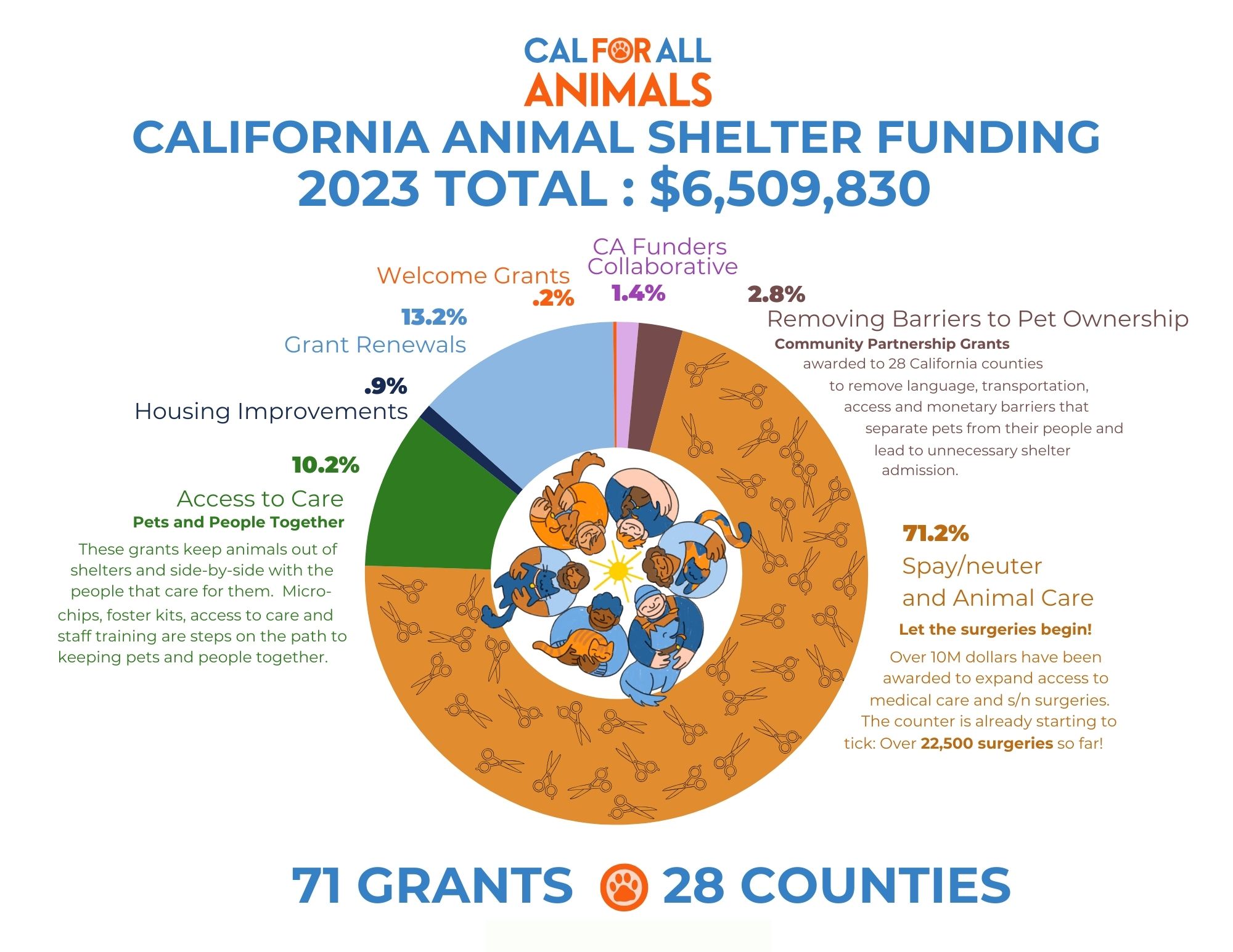
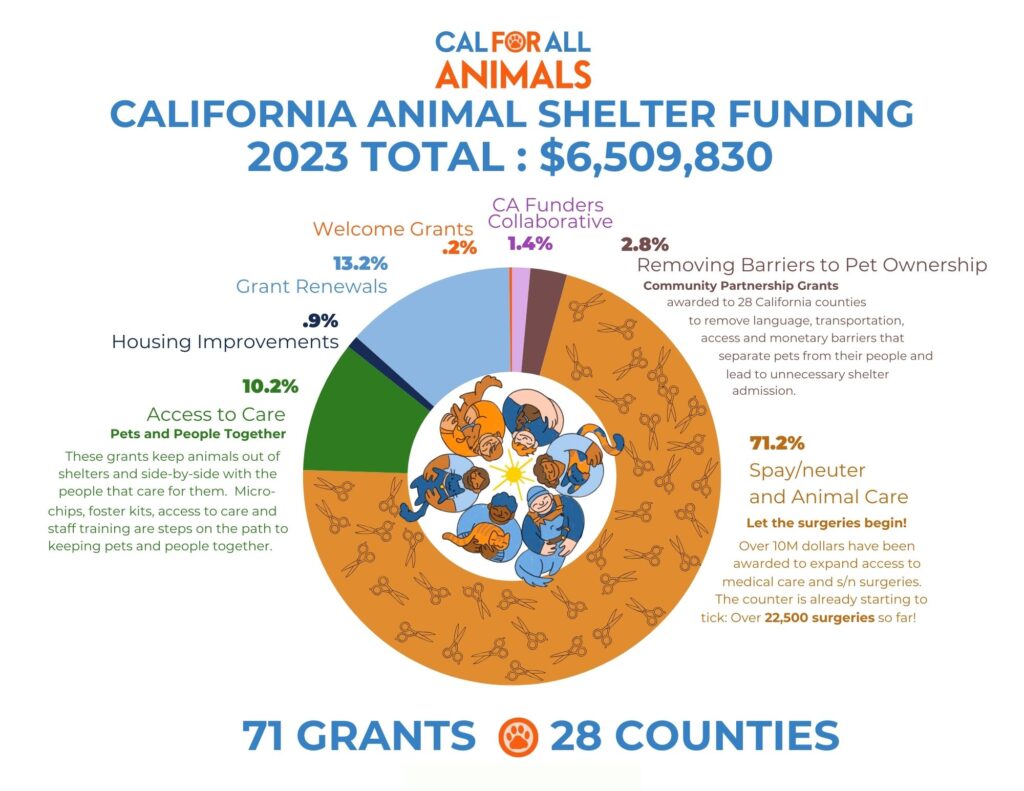
In just over two years, the California for All Animals program has provided nearly $31.5 million in funding to animal shelters across the state. Funding has supported spay/neuter surgeries, veterinary care, supplies, equipment and staffing to keep pets and people together. The 2023 funding strategy was to provide support and partnership on grants awarded in 2022, continue to bridge the 3M spay/neuter surgery gap created during the Covid-19 pandemic, and continue to remove barriers and expand access to care.
Read below to learn more about how the 6.5M 2023 grant support was distributed to support California families and their well-being.
Grant funding has been awarded for shelters to expand surgery capacity and partner with spay/neuter organizations such as CAMP LA, SNIP Bus, Valley Oak SPCA, and Animal Balance to provide low-cost or fully subsidized spay/neuter, vaccinations, and microchips to keep pets in their homes and prevent additional litters of puppies and kittens. Accessible spay/neuter promotes animal health, stabilizes community cat populations, and reduces the number of animals entering shelters. Over 4M dollars was awarded in 2023 expand access to spay and neuter.
Grants made to animal control agencies and municipalities with animal control officers help keep pets in homes. Providing supplies like pet food, crates, fencing repair, and outdoor trolley systems keep pets with the families who already love and care for them. Supportive practices build relationships and address root issues that result in pet homelessness. For example, working with the community to help lost animals stay in their neighborhood improves the chances of that pet returning to their home by a factor greater than 10! Solution-focused programming allows animal control officers to move away from costly, punitive programming that breaks the bonds between pets and families and fills our shelters with pets who already have homes. Resources can be reallocated to focus on animals who do need intervention and enforcement, such as intentional cruelty, domestic violence cases and suspected dog fighting or cock fighting. Over $100,000 dollars have been awarded to support animal control agencies building proactive programs.
Grants made to ensure essential pet services are accessible and inclusive for all Californians. Funding prioritizes bridging the gap between animal shelters and communities that have been disproportionately impacted by racial and economic inequities.Translating materials, hiring multilingual staff and collaborating with human service agencies and other community-based organizations ensures animal shelters can partner with all community members to keep the pets they love by their side.. Over $200,000 dollars have been provided to bridge the gap between California families and access to essential services and resources.
Grants made to community support programs that keep pets with their people. When people are suffering, their pets are too. Animal shelters are partnering with human services agencies and community-based organizations to provide food and supplies, behavior and training services, vaccine clinics, veterinary care, and temporary crisis boarding to keep pets with the people who care for them. Programming and partnerships also provide crucial support and advocacy for Californians experiencing homelessness or domestic violence, with a focus on pet- and people-centered support that removes barriers to accessing safe and permanent housing. Over $500,000 dollars have been awarded to support California programs that keep pets in their homes.
Grants made to foster programming keep vulnerable pets out of shelters. Engaging community members in the temporary care of kittens, puppies and any other pet who would benefit from a home environment allows pets to benefit from socialization and extra care. Shelters are providing the supplies and medical care needed to support foster caregivers preparing animals for adoption. Foster programs allow shelters to expand the care they give to animals in need, reduce the transmission of diseases, increase adoptability of all animals, and reserve space and resources for the most vulnerable animals, those who are injured, receiving extensive medical care or in need of secure housing due to behavioral or custody concerns. Over $500,000 thousand dollars have been awared to keep vulnerable pets out of the shelter.
Grants made to support the care of animals in the shelter improve the well-being of both animals and staff. When animals do need homes, funding provides for the physical, medical and mental well-being of animals who are in the shelter’s care. This includes veterinary care supplies and services, behavior and enrichment, volunteer programs, equipment and supplies, and housing improvements. Every single shelter in California has been invited to upgrade to double-compartment housing which reduces the spread of disease and improves staff safety. See the housing map here: https://www.californiaforallanimals.com/grants/portal-grants/Over $300,000 dollars have been awarded to support the care of animals housed in California shelters.
As part of our More Pets and People Together campaign, we’re asking community members inside the shelter and out, “What do communities look like when we’re stronger side by side? What does More Pets and People Together mean to you?” Together we’re envisioning and creating communities that keep and bring pets and people together, places rooted in mutual care, joy, and connection, where everyone belongs.
RVT and former shelter manager Ivy Ruiz reflects on what gave her courage to positively disrupt the status quo when change didn’t seem possible.
As a shelter manager, I kept my office doors open—one led to the public lobby and another to the front office—but this time I shut them both. I had to melt down where no one could see, in the comfy chair next to the bowl of peppermint patties that everyone set aside, next to the clock that ticked all day but never got the time right. I brought my knees to my chest, buried my face, and cried.
That afternoon, a woman had walked into the shelter to reclaim her dog, a Chihuahua Terrier mix, and staff explained the policy: if she couldn’t pay the reclaim fees, her dog would have to stay at the shelter. When I was pulled in as the supervisor, I could only say the same.
I thought I knew what would happen next, because it happened again and again. People would make it all the way across town to reclaim their pets, sometimes by taxi, bicycle, borrowed car, or even by foot. Like other shelters, ours was on the outskirts, far from any bus stop. But without enough money to pay the fees—which accumulated quickly to hundreds of dollars and could include daily boarding fees, civil penalties, impound, license, and vaccine fees, all set at the city level—folks would have to leave empty-handed.
Sometimes they would threaten me or another staff member, or throw pens or clipboards at the glass between us. We were on the other side of the desk, but we felt the same emotions: anger that things couldn’t be different, frustrated that we were caught in the middle, sad that people in our community thought we were heartless.
Who could blame them? Often it felt like we were holding their dear family member hostage.
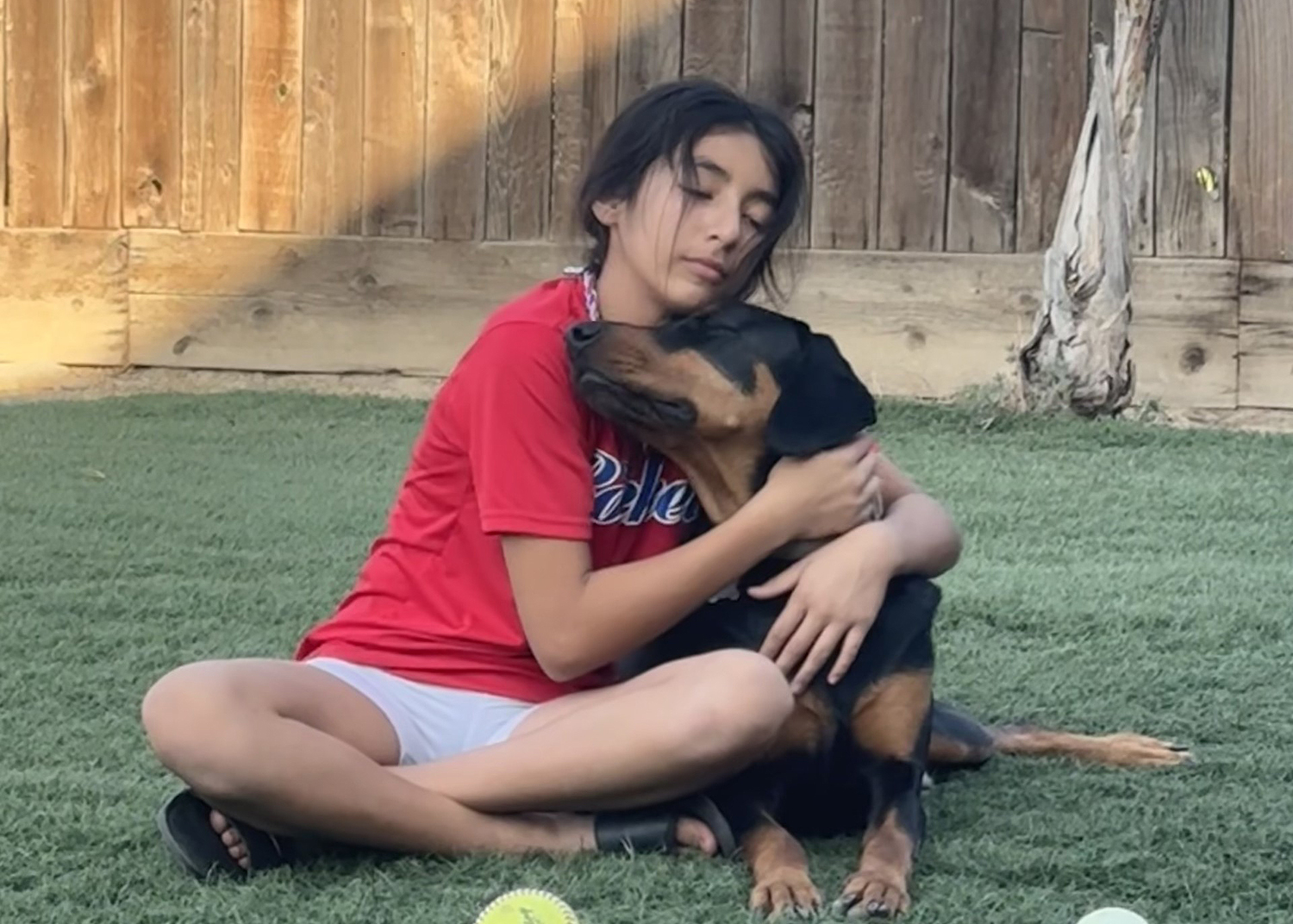
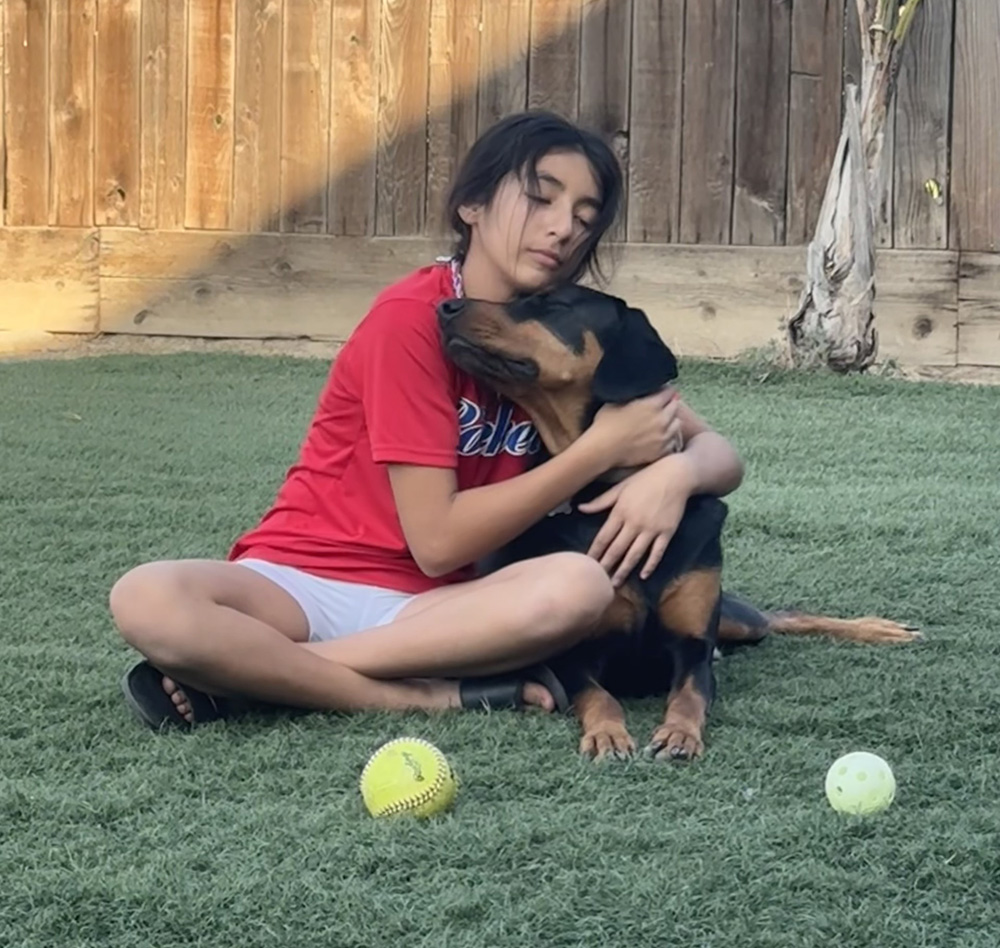
Ivy’s daughter Xani hugs her dog Renzo
If we weren’t sending a pet home with their family, that meant more nights waiting at our facility, putting that pet and others at risk of disease, and causing families like this one a great deal of pain and trauma.
Ivy Ruiz
But when I told the woman she couldn’t take her dog home, she didn’t get angry. She cried. She pleaded. “I’m a single parent with three kids,” she said. “I’m doing my best.”
She refused to let me or this policy define her or her pet’s destiny. These fees were created for a family with double her income, she said, with a salary more than minimum wage. And if her family didn’t exactly fit that mold, it didn’t mean that they were less deserving of bringing their dog home.
My heart broke and kept breaking in my office after she left without her dog, because she was right: There is no such thing as being too poor to love pets. Ours wasn’t an affluent community—even families with two incomes struggled. Her dog would wait at our shelter for several days or even weeks while fees continued to add up, until the only option for her and all the folks in the same situation was to surrender their pet permanently to the shelter, because that fee was more affordable than taking them back to the home they knew.
I was tired of setting community members, animals, our shelter and my staff up for failure. If we weren’t sending a pet home with their family, that meant more nights waiting at our facility, putting that pet and others at risk of disease, and causing families like this one a great deal of pain and trauma. It also meant higher costs to house, feed and care for animals who already had homes—and people who missed them and loved them the way they wanted to be loved. Despite all this, city officials refused to change a policy that, in their eyes, generated revenue.
This powerful video from Memphis Animal Services shows the magic that happens when best friends reunite—and why fees shouldn’t stand between them.
My office clock ticked on, adding up all the harm I’d caused by enforcing fees and policies designed years ago, ones that no longer—or had never—served my community. Watching this play out with family after family harmed me too. It strained my mental health and made it harder to see clearly or feel empathy.
I opened my door and asked the front office assistant to call the woman back and tell her she could pick up her dog, no cost. The minute he saw her, he whimpered and wagged his tail. She kneeled down, and the dog came running.
My staff and I never looked back. Sometimes we could waive all fees without drawing attention, sometimes we could waive partial fees, and sometimes we couldn’t waive any, which is when we would scramble to cover the tab. If we had to chip in to get a pet home, we did.
It’s been years since I sat in that office, afraid of putting my job on the line by going against a policy I’d been told to follow and deciding, again and again, to do it anyway. Today, more and more shelters are fighting against unfair and ultimately unsuccessful policies and winning. They are positively disrupting systems that don’t serve anyone. At the time, I knew if I couldn’t find the courage to do what was right moving forward, I’d have to find the courage to leave this profession.
My window faced the public parking lot, but that first afternoon as I waited for courage, I didn’t notice the woman in her car, waiting too. She’d stayed in the lot the whole time; staff told me later. Maybe some part of her was unable or unwilling to leave, not without her dog.
Instead, I watched a nest that, one spring, a mama bird had built for her babies. Each year, sometimes twice, the birds returned to the comfort and safety they’d found in that spot.
Instead, I was asking myself the questions I want to ask you now.
Why can’t the shelter offer the same sense of comfort and safety for all people in our community?
What if communities refused to set expensive reclaim fees—or changed them—knowing that most of us would not be able to afford them?
What if, together, we refused to lose sight of what pets mean to their people?
Read more about what we can all do to rethink reclaim fees and help pets get back home.
Ivy Ruiz joined the UC Davis team as the new Outreach Specialist for the Koret Shelter Medicine Program in September 2022. Ivy has a long history in shelter care and medicine; she is a Registered Veterinary Technician who has worked in high-capacity shelters in California. Her passion for animals led her to a position as a Superintendent for the City of Visalia’s Animal Services Department where she trained her team to create change that would dramatically improve animal save rates in the city.
More Pets and People Together main page
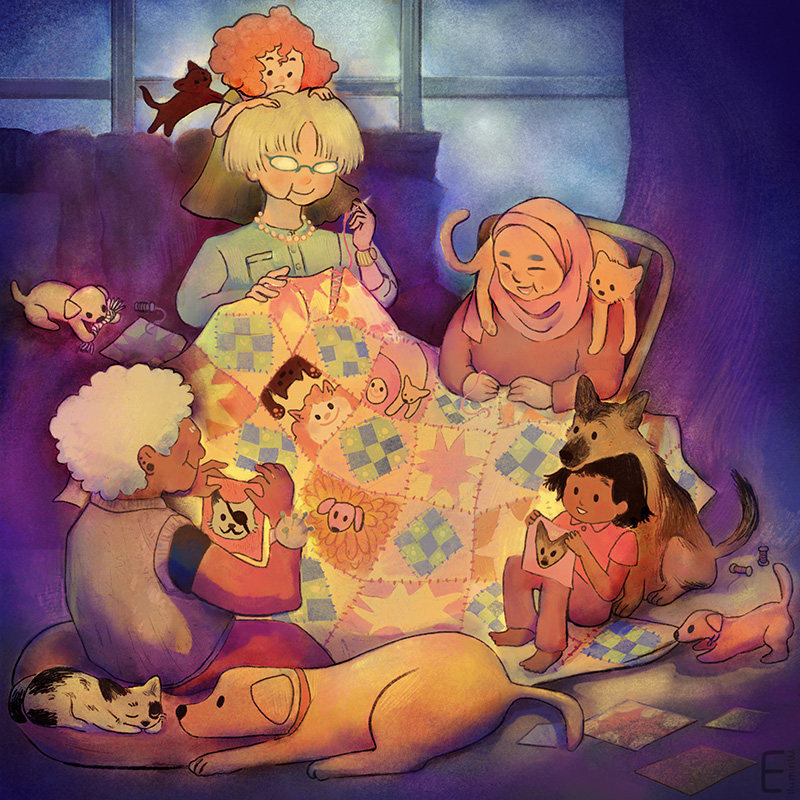
As part of our More Pets and People Together campaign, we’re asking community members inside the shelter and out, “What do communities look like when we’re stronger side by side? What does More Pets and People Together mean to you?” Together we’re envisioning and creating communities that keep and bring pets and people together, places rooted in mutual care, joy, and connection, where everyone belongs. Artist Erika Ilumin Wahlberg tells us more about her vision and why building bridges and removing barriers to keep pets and people together is important to her.
What drew you to this project?
I may not be an illustrator whose expertise lies with animal art, but the focus on community bonds really resonated with me!
It’s also important to address barriers for pet owners when it comes to affordable vet care. I remember the panic I felt the one time I called an emergency vet clinic on behalf of a friend, and wondering if my friend’s dog would be okay to wait for a day or if it would be “worth it” to go to the 24-hour clinic and possibly take on expensive fees we couldn’t afford. Luckily his pet was okay to last the night before seeing his regular vet, but I know if the situation was more dire and he didn’t have the money to spare for emergencies—it could easily have been more stressful.
How have animals impacted your life?
Though I don’t have a dog of my own, I have spent many weeks dog-sitting for my aunt.
Her dog, Maile, is a really sweet Shih Tzu and Lhasa Apso mix. When I got knee surgery and was stuck on the couch for an entire week, she would lie on the floor in front of me the entire time—the tiniest guard dog! I felt very helpless at that time, so it was always comforting to see that she was always there watching how I was doing.
Playing with one another is how we become stronger as a community. Play is the way we connect with pets, and I hope we carry that over in bringing play into our relationships with people!
Illustrator Erika Ilumin Wahlberg
How would you complete this sentence? More pets and people together, more _____.
More pets and people together, more play! The bonds we have with our pets, I think, reflects the best part of our human qualities: unconditional love. Pets create connections through play, which is something we forget how to do the older we get. Pets remind us to care for each other for the sake of caring, and to remember to play with each other no matter what age we are.
Playing with one another is how we become stronger as a community. Play is the way we connect with pets, and I hope we carry that over in bringing play into our relationships with people!
What do you hope your art inspires in the world?
I hope that everyone could see themselves, or someone they love, in my art. I hope that they think of the pets and people in their life and feel like they’re part of something greater.
Everyone deserves to feel like they’re part of something. In the case for this work, part of the quilting circle!
Erika Ilumin Wahlberg is a California based writer-illustrator with a love for fantasy and everything delightfully strange. Her work centers around stories with happy endings because she believes that dreaming of a better future is how we can imagine solutions to reach it. To see more of her work visit eilumin.com and follow her Instagram @eiluminart.
This month marks the launch of our More Pets and People Together campaign, and we’re asking community members inside the shelter and out, “What do communities look like when we’re stronger side by side? What does More Pets and People Together mean to you?” California for All Animals Program Manager Nadia Oseguera-Ramón introduces the campaign and reflects on the word and action at its heart: Community.
I first joined animal welfare as a kitten foster. My partner and I were picking up food from a pizzeria when we encountered a group of cats living outside the strip mall just a few blocks away from our local animal shelter. They were wisely hanging out near the garbage cans behind the businesses, robust enough to indicate they’d been looked after and were dining on more than just scraps. We saw cans of cat food and bowls of water, and later we’d meet the kittens tucked away in the bushes, the ones who would end up coming home with me.
But first, in the businesses and surrounding homes, we met the community members caring for the cats while working and living in the area. Some were feeding the cats; others were actively trying to get them altered, or fostering the kittens and placing them in adoptive homes. They told us spay/neuter resources were scarce, and they’d been taking the cats one or two at a time when a spot opened up at a mobile clinic. We connected with FixNation and another organization that let us borrow traps, and the business owners, neighbors, and my partner and I launched a coordinated effort to trap, neuter, and return multiple cats at a time over a series of nights. Together, we altered the rest of the pizzeria cats and found fosters for the kittens. After that, business owners were more than happy to be on alert for any newcomers.
A couple years later, I started working for a foster program based out of the animal shelter near the same pizzeria. I quickly learned that kitten fostering was as much about the people as it was about the kittens. Every time I sent kittens or cats to their foster homes, I experienced the joy of facilitating an animal-human connection, and it was especially rewarding when it was with a first-time foster. I was uplifted not only by offering them support and grace as they were learning the ins and outs, but also by connecting them to hundreds of foster caregivers linked by their love of all things cat. They offered one another consolation after the loss of a kitten, shared caregiving advice and joined together to find adopters.
Once I’d been a novice foster taking on the challenge of learning too, and I knew that the more accessible fostering was, the more people would be able to help, and the more kittens we would be able to help together. Welcoming fosters into a larger community was part of that.
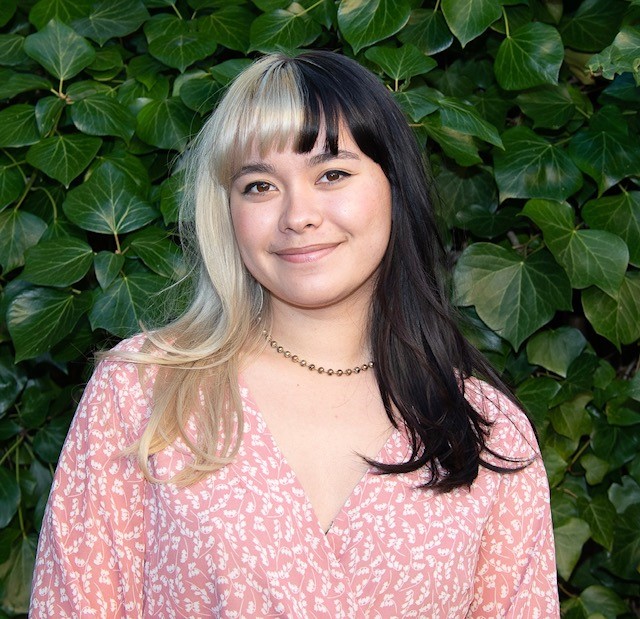
Click the image to learn more about artist Jade Howe
When barriers are replaced with bridges, it signals to people outside the shelter that there is an opportunity for a collective effort to address the needs of the animals in the community.
Nadia Oseguera-Ramón
More Bridges, More Community
While circumstances vary from county to county, I often hear how receptive your community members are when you invite them in by offering low-cost or free spay/neuter, translating materials to other languages, or reducing or waiving fees…and more. It’s indisputable that animal shelters carry a lot of responsibility on behalf of their communities — you’re often tasked with covering a huge service area. However, when barriers are replaced with bridges, it signals to people outside the shelter that there is an opportunity for a collective effort to address the needs of the animals in the community.
Our More Pets and People Together campaign and upcoming grant cycle will help shelters in California continue your important work of lowering barriers and building bridges by providing critical tools and funding to support the shifts you’re making one step at a time, during a challenging time. I hope you’ll share the campaign page and calls to action with your community and municipal stakeholders to reinforce your efforts; request a communications kit with colorful posters, buttons and stickers to share inside the shelter and out; get involved in a statewide art contest to win $5k for your shelter, and gather with your peers to celebrate the meaningful work happening across the state and country in our series of virtual roundtables.
Removing barriers is not one-size-fits-all, and it’ll look different depending on each shelter’s circumstances or available resources. With each incremental change and barrier removed, there is a new opportunity to facilitate an animal-human connection and build trust and partnership with community members, business owners and organizations.
When I think about reducing barriers to outcomes to welcome in more fosters and adopters, I see those thriving cats outside the pizzeria and their tiny kittens peeking through the bushes. I see the entire network of community members who had already stepped in to make sure they would be okay, and what we accomplished together. Out of a desire to protect animals and ourselves, it can be easy to assume people don’t care about the animals living alongside them, and this fuels the establishment of barriers that prevent people from accessing services or experiencing the joys of bringing an animal home. In reality, just blocks away from a shelter, this community of compassionate caretakers, fosters and adopters was already taking matters into their own hands to keep free-roaming cats healthy in their home and help kittens find new ones.
And when I think about what More Pets and People Together means to me, I think about community — as both a place in which people co-exist and the act of being in community with others. When we assume most people do care and want to help, we can truly be in community as we all work together to keep and get more animals home. I’m grateful to be in community with all of you, and I’d love to know: What does More Pets and People Together mean to you? What steps is your organization ready to take to strengthen community, and how can we help?
Nadia Oseguera-Ramón joined the Koret Shelter Medicine Program (KSMP) in September 2022 as California Program Manager. Her desire to help animals combined with her profound understanding and appreciation for people’s diverse experiences and motivations encouraged her to pursue a career in animal welfare.
During her five years with the American Society for the Prevention of Cruelty to Animals (ASPCA), Nadia managed a high-volume feline foster program in collaboration with the Los Angeles County Department of Animal Care and Control (DACC).
This Year’s Recipients Are Working Towards Keeping People and Pets Together
$300,0000 Granted in an Effort to Break Down Barriers That Are Causing California Shelters to Remain Full
Two dozen animal shelters across California will receive grants through the California Animal Welfare Funders Collaborative (CAWFC). The collaborative, launched in August 2019 by Best Friends Animal Society, Annenberg Foundation, California for All Animals, Maddie’s Fund, and Michelson Animal Foundation, offers a unique funding model created to bring about a transparent and comprehensive funding ecosystem whereby funders pool their money together to provide a more streamlined process that fosters a deeper partnership.
The most recent round of funding will provide $300,000 to California shelters bridging the gap in their communities between at-risk pets and essential care, such as vaccinations, microchips, medical services and other support services, like help securing pet housing or emergency foster care.
The funding cycle kicked off earlier in July and will end in June 2024.
A breakdown of the grants awarded
A total of $35,000 in grants was given to Southern California organizations, including:
$10,000 to Los Angeles County Department of Animal Care and Control for resources to support their pet retention programming
$10,000 to Chula Vista Animal Services for vaccine clinics and spay/neuter for owned pets
$5,000 to City of Los Angeles Department of Animal Services for resources to support their pet food pantry
$5,000 to Heaven on Earth Society for Animals to launch their Kitty Behavior Bootcamp
$2,500 to Rancho Coastal Humane Society for for resources to support their Doggie Day Out programming
$2,500 to San Gabriel Valley Humane Society for resources to support their dog and cat enrichment program
$76,500 in grants was given to organizations in Central California, including:
$15,500 to Kings County Animal Services to support their Return-to-Owner programming in shelter and in the field
$10,000 to City of Bakersfield Animal Control to support spay/neuter and identification for owned pets
$10,000 to Inyo County Animal Services for TNR of their community cats
$10,000 to Friends of the Animal Community for their Seniors for Seniors program that pulls senior dogs at risk from other shelters
$10,000 to Kerman Police Department for their TNR and Surrender Prevention programs
$7,500 to Animal Shelter Assistance Program (ASAP Cats) for intake diversion through medical care for owned and community cats
$7,500 to Visalia Animal Services for TNR in their contracted cities
$6,000 to Bakersfield SPCA to increase Return-to-Owner rates with ID tags
$188,500 in grants was awarded to Northern California organizations, including:
$60,000 to Siskiyou Humane Society for a van to continue operations
$40,000 to Stanislaus Animal Services Agency to enhance their clinic capabilities through equipment modernization to better support their community
$24,000 to FieldHaven Feline Center for their Kitten Sitter Program that diverts kitten intake
$18,500 to Tehama County Animal Services for their monthly vaccine and microchip clinic for owned pets
$10,000 to Rancho Cordova Animal Services for community support helping owners retain their pets
$10,000 to Nine Lives Foundation to launch a HQHVSN training program for local vets
$10,000 to Friends of the Alameda Animal Shelter (FAAS) to support their Skyla Fund (medical services for pet retention)
$7,000 to Town of Truckee Animal Services for intake diversion through services to the community
$5,000 to Cat Town to expand their Kitten adoption program in retail locations
$4,000 to Contra Costa Humane Society to support their county shelter with kittens
The most popular page on Sheltermedicine.com is “Caring for Kittens from Birth to Eight Weeks,” Chapter 2 of the online Guide to Raising Unweaned & Underage Kittens. The guidebook is part of the shared resource library developed and maintained jointly by veterinarians in the UC Davis KSMP and the University of Wisconsin-Madison Shelter Medicine Program.
First published in 2017, the guidebook was recently reviewed from tip to tail and substantially revised to reflect the most current terminology and practices around caring for unweaned and underage kittens in shelter and foster environments. The new revision received input from shelter veterinarians from UCD and UW, and was updated with the assistance and expertise of Marnie Russ, Neonatal Kitten College Program Administrator, Animal Welfare League of Arlington.
“Kittens! We’re all so excited to be the go-to for caring for our youngest, most vulnerable population – who bring us so much joy, and so much stress all at the same time. This guidebook revision brought together the expertise, experience, and research from an array of folks who have helped an innumerable number of kittens. Some of it is new learnings to be shared and some of it is consistent throughout time. It is our hope that this is a trusted source to help everyone doing the work.”
Dr. Cynthia Karsten
Other Guidebooks currently available in the library:
108 California organizations applied for the Open Arms Challenge this year. They spent last month preparing—updating procedures, training staff and volunteers, engaging translators to reach more people in more languages, etc.—and are implementing their welcoming practices this month.
At a recent Open Arms Office Hours call, we heard how a rescue is thinking of new ways to reach people in their communities (flyering and tabling at events, for example, instead of exclusively recruiting online) and a shelter is working to undo the bad feelings created by the unwelcoming policies they’re replacing. The next Open Arms Office Hours call is Thursday, April 27. Register here to attend and let us know how you’re doing. If you’ve encountered an unexpected challenge, maybe somebody else on the call will have already solved for that very thing. Or maybe you’ve discovered a great tactic you’d like to share with others.
Shelters and rescues will report on their initiatives in mid-May, and in September the 22 organizations sponsoring the Challenge will announce the winners of $420,000 in grants.
Together with her husband, Marvin Adams, Margaret Wagner has opened her door and her heart to dogs in need of a home again and again. Whether it’s a Craigslist or Facebook post for a dog seeking a new home or a temporary place to stay, Margaret answers, and while a dog is in her care, she gives them all she’s got. There was the time she turned a malnourished farm dog around with chicken and rice. Or the time her daughter saw a German Shephard puppy left in the park and asked, would she be able to take her in?
And then there is Coco.
Margaret met Coco’s first family via Facebook; they’d had to leave their home but hoped to find another within a year, and they needed a longer-term foster for their Rottweiler. Margaret said yes, even as she knew it would be difficult to bond with Coco only to lose her. If she could help her avoid the stress of entering a shelter and ease the family’s transition, it would be worth it.
The connection was immediate, especially between Coco and Marvin. Even Tinkerbell, Margaret’s Chihuahua, approved. Coco’s family saw it too, and after several months, which included occasional weekend visits with Coco, they asked Margaret if she would like to adopt her. Again, Margaret said yes, “in a heartbeat.”
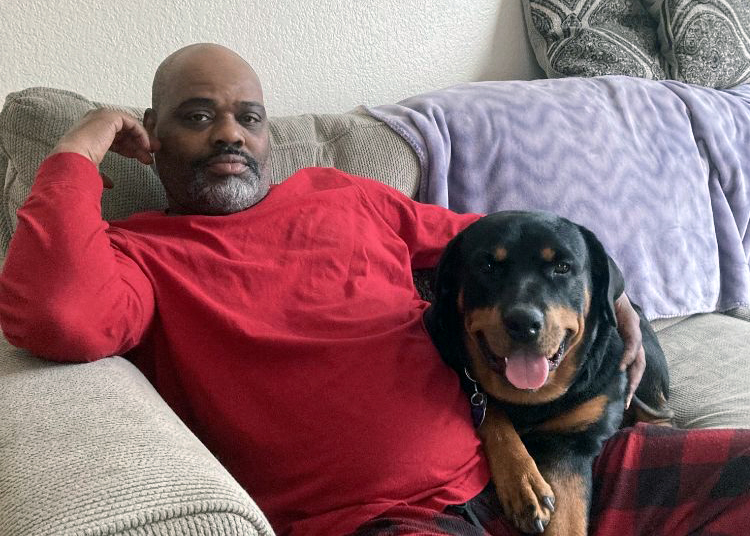
Determined to find help with vet care for her family’s dog Coco, Margaret searched for resources far and wide until she connected with Animal Services Officer April Stevenson. Thanks to Margaret’s perseverance, Coco is now back to cuddling with his favorite person, her husband, Marvin. (Credit: April Stevenson, left; Margaret Wagner, right.)
Coco proved to be a constant in a year of challenges: Margaret lost her job, and Marvin, who was diagnosed with congestive heart failure, began wearing a LifeVest to lower his risk of cardiac arrest. Coco, now registered as a service dog, never left his side. Then Margaret noticed sudden swelling in Coco’s back paws. A trip to the vet confirmed Coco would need further testing to pinpoint the cause, but the cost was out of reach.
Like many Californians struggling to find affordable veterinary care while availability shrinks, Margaret searched for support, determined to get Coco the treatment she needed, but came up against more barriers. “I had a notebook with four pages full of websites and agencies,” she says. “I applied at so many and got rejected from so many that it was heartbreaking, you know?”
In the living room with her husband, Coco resting on her favorite loveseat, Margaret realized to get Coco help, they would have to give her up.
It was the hardest decision I’ve ever had to make in my life.
—Margaret Wagner
Moving forward together
“I just looked at her, and I said, ‘I can’t do this anymore, babe. I can’t.’ I just started crying and I said, ‘I can’t watch her suffer.’ She had lost weight, and she had stopped eating, and she could barely walk. She wasn’t her happy-go-lucky Coco. I said, ‘We have to surrender her as much as we hate to.’ It was the hardest decision I’ve ever had to make in my life.”
She called 311 and was forwarded to Rancho Cordova Animal Services’ voicemail. It was 9 p.m. on a Saturday. Margaret didn’t expect to hear back, but then Animal Services Officer April Stevenson called. She listened to Coco’s story and said yes—not to transferring her to the shelter, but to teaming up with Margaret and Marvin to make sure Coco received the treatment she needed that weekend, thanks to Rancho Cordova’s Community Support Program. The program, established with funding from a California for All Animals grant, is one example of animal services agencies, shelters, and communities tackling systemic barriers that separate families and lead to pets who already have homes entering shelters.
“[This situation] started out sad, and it turned into this beautiful thing so quickly, all because of the grant,” says April.
After a trip to the emergency vet and medication to address the infection, Coco is back to her happy-go-lucky self, and she’s back at Marvin’s side. “She follows him everywhere. She lies either on the floor next to his side of the bed, or she’ll sleep at the bottom of his feet.” Margaret laughs. “Or if he is more towards the middle on my side, then she’ll lay right next to his side. That’s just how she is. That’s his baby.”
Stronger Side By Side: Meet CocoMargaret Wagner reflects on what it means to have Coco in her family.On how she’d describe Coco to someone who’d never met herA big, giant teddy bear. A heart of gold.On Coco’s favorite gamesI took her to get her one-year booster [at the animal shelter]. They have toys, leashes, harnesses, cat stuff. So they gave me some tennis balls, and there was also this wishbone. She hasn’t been able to chew through it yet, and she loves it. That’s her favorite toy in the world. My husband will take her to the park, and they’ll play tug of war, Frisbee, tennis balls.On Coco providing comfort during difficult timesMy husband ended up in the hospital shortly after we got her. When the paramedics came that day to get him, it was all I could do to keep her in the room. She was almost tearing my door down to get back out here with him. And when he came home from the hospital—she doesn’t leave his side—she was even more connected with him. I knew that she knew that there was something wrong with him.On Coco’s happy danceShe jumps up on her back legs and barks. Her tail is this tiny stub, so when she gets excited it’ll stick up a little bit, and her whole back end shakes.On rituals and greeting her dadAs soon as Coco hears that particular truck and trailer come in here, she knows. She’ll be asleep on the loveseat and then her head will pop up. She’ll listen, and then she’ll run to the door and start whining. Her little tail will just be shaking. And as soon as he comes in the house, man, she’s jumping on him. Daddy, daddy, daddy, daddy! He’ll sit down and take his shoes off, and she’ll sit on his feet and nudge at him, and she’ll give him kisses. And it’s funny because she doesn’t really lick you; she’ll put her cold nose on you.On a joyful momentIt was about three weeks after we got her and Marvin had to go to work. He had the LifeVest on at that point, and he sat down to put his shoes on, and she wouldn’t let him put his shoes on! She wouldn’t let him walk out the door. She grabbed [a shoe] by the shoestring and took it away. I had never laughed so hard in my life. My husband goes, ‘Coco, bring me my shoe.’ And she came out of the room without a shoe, like, I don’t know what you’re talking about, Dad, and then she jumped on his lap and wouldn’t move. I was like, Coco, Daddy’s gotta go to work! And she just looked at me like, I don’t know who you’re talking to.On finding out Coco wouldn’t have to enter the shelter to receive careI just bawled. And I looked at my husband and I said, Honey, God is good all the time, because he is really, really with us right now. I told him why, and he just started crying. We looked at Coco and it was like, I think she knew after he started crying. I think she knew that it was all gonna be okay, because she jumped up like there was nothing wrong with her, and she just got happy. She was giving him kisses, like, I’m gonna be okay, Dad. Don’t cry. It was like she knew at that moment that she was gonna be better.On the three best things about having Coco in the familyThe companionship, the love. And then my husband has to exercise for a certain amount of time during the day, and she gets him up to go for a walk. She motivates him.On why every community needs a program like thisThere’s been plenty nights where I’ve cried just thinking about it. I have a reminder every day because I look at her, and I see that she’s gotten better, and I’ve got my Coco back. There are going to be other animals, other families that are in a hardship like me and my husband, and there’s a chance that they’re not going to lose their loved one, like we didn’t lose Coco.
Previous
Next